The rapid development of artificial intelligence has presented organizations with a new kind of challenge. Until recently, it was enough to provide employees with access to large language models, such as ChatGPT or Perplexity, and encourage them to try using them as part of their daily work. However, this era of independent AI use is only the first step in a broader transformation.
Microsoft's annual Work Trend Index reports indicate that we are moving from mere individual AI assistance towards hybrid work communities where humans and autonomous AI agents operate as teams. This transition is not merely a technological upgrade, but it requires organizations to adopt a completely new kind of operating model and leadership.
In this blog post, we dive into how organizations can move from the early stages of AI adoption toward dynamic, agent-based ways of working. We will walk through the three phases of the AI journey, the four modes of human-AI interaction defined by Microsoft, and the practical steps your organization can take to make the next big leap.
Three phases of artificial intelligence adoption in an organization
Microsoft's AI research and lifecycle models divide organizations' journeys with AI into three distinct phases of development:
Step 1: Individual AI usage (AI as an assistant)
In this first stage, organization members have access to some kind of artificial intelligence tool – for example, ChatGPT, Perplexity, or Microsoft Copilot. Employees use these tools independently to enhance their own tasks, such as drafting emails, searching for information, or summarizing texts.
This phase is experimental and sporadic in nature. Most organizations are currently at this exact stage. Although an individual employee's productivity may increase, the benefits of AI remain isolated islands because they are not integrated into shared processes.
Step 2: Teams of humans and agents (AI as a colleague)
In the second stage, we enter the era of true process integration. While in stage 1 a human uses AI as an interactive sparring partner, in stage 2 the human outsources an entire process or part of it to an AI agent. This AI agent is capable of performing tasks delegated to it autonomously in the background, without the human needing to guide its every step.
At this point, artificial intelligence becomes a ”digital colleague.” The employee's role shifts from a doer to an organizer and coordinator of work who delegates tasks between humans and AI agents.
Phase 3: Humans lead, agents execute (Agent Armies)
In the third and most advanced phase, the organization relies on an extensive network of agents, or an ”agent army.” The agents independently handle routine, manual, and repetitive processes from end to end.
The human role at this stage is purely strategic and supervisory: the human ”oversees,” directs the whole, makes critical decisions, and ensures that the work performed by the agents meets the organization's quality and ethical requirements.
In Microsoft's 2025 report 2025: The year the Frontier Firm is born such an organization is described as Frontier Firm. These ”pioneer companies” aren't just gluing AI onto old processes; they are completely redesigning their business models around the capacity provided by AI agents.
How to move from phase 1 to phase 2?
The biggest hurdle for organizations is transitioning from the first phase to the second. How do you move from employees doing random searches in a chat window to workflows being delegated to autonomous agents?
According to studies by Video Expert and Microsoft, the solution lies in first understanding and mapping out how the organization currently operates. For this mapping, Microsoft's latest 2026 Work Trend Index report Agents, human agency, and opportunity provides an excellent framework: four operational modes of human-AI collaboration modes of working with AI.
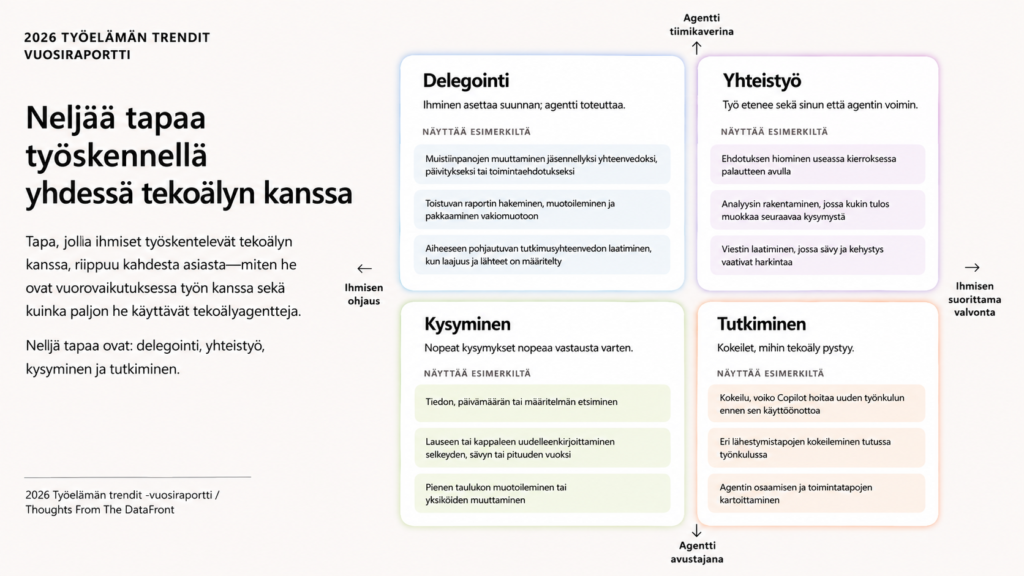
These four modes of operation are Asking, investigation, delegation and cooperation. They are placed in a four-quadrant grid based on how actively a person participates in the work and how independently the AI agent operates.
Four-quadrant model of human and AI agent collaboration
The following table illustrates how these four states are distributed according to agent autonomy and the human role (guidance vs. monitoring):
| Agent assists (Lighter AI involvement) | The agent acts independently (Deeper AI involvement) | |
|---|---|---|
| A human is clearly in control Active direction | Asking • Spontaneous questions and searches • Quick answers and summaries | Delegation • Outsourcing a task or process to an agent • Agent runs work in the background |
| A human oversees it Oversight | Exploration • Ideation, scenario mapping • Collaborative exploratory development | Collaboration • Close parallel working • Continuous interaction and fine-tuning |
This quadrant shows that the use of AI is not an ”either-or” question, but a dynamic relationship that adapts according to the task at hand.
A deeper examination of operating environments
To understand how the transition from phase 1 to phase 2 happens in practice, the organization must master all four forms of interaction:
1. Asking
- How it works: A human provides a single input or question, and the AI assistant provides an immediate response.
- Example: ”Summarize this long email thread into three main points.”
- Roles: The agent acts as an assistant, and the human directs the interaction very precisely and straightforwardly. This is the most typical way to start using artificial intelligence (Phase 1).
2. Exploration (Exploration / Investigative Work)
- How it works: Let's use artificial intelligence to map out opportunities, analyze data, and find new perspectives.
- Example: ”What risks and opportunities are associated with this new market strategy, considering the latest market trends?”
- Roles: The agent assists in complex information retrieval and analysis, but the human oversees the process, challenges the ideas generated by the artificial intelligence, and makes the final conclusions.
3. Delegation
- How it works: A human defines the desired outcome and constraints, and hands over the execution of the work entirely to an AI agent.
- Example: ”Here is the raw data and notes. Create a weekly project report from them, format it into the ready template, and email it to the team every Friday morning.”
- Roles: The agent performs the work independently from start to finish, and the human guides the process by setting the goals and approving the final outcome. This is a typical Phase 2 operating model.
4. Collaboration
- How it works: Human and agent act as partners, both playing a significant role during the process. This is a continuous dialogue and iterative development of work.
- Example: A software developer writes code together with an agent, where the agent suggests solutions, the developer corrects them, and the agent learns from feedback on the fly.
- Roles: The agent works independently, but a human continuously supervises and spars with it along the way.
”Discernment” separates the pioneers from the rest
According to Microsoft's 2026 Work Trend Index report, the most advanced users of AI, who are called Frontier Professionals, do not stand out from others just because they would use artificial intelligence more. What sets them apart is the ability to demonstrate judgment (discernment) – they know how to choose the exact right course of action for each task.
Research reveals that advanced users more often take a break before starting work and ponder: Should this task be given to AI, a human, or done together?
- 53 % advanced users make this conscious choice regularly, whereas only of less experienced employees does this 33 %.
- Plus amazing 86 % users understand that the output produced by artificial intelligence is only a starting point, not a ready-made answer, and that the responsibility for thinking and quality always remains with the human.
Practical steps in transitioning from phase 1 to phase 2
How can your organization practically initiate the transition towards autonomous agent teams? The following three steps help lay the foundation for success:
Step 1: Mapping current working methods (”Mapping”)
The first step is ”mapping” recommended by an expert, which means surveying current working methods. Find out how artificial intelligence is currently used in your organization:
- How many employees actively use artificial intelligence?
- What tasks is it used for (e.g., just asking questions)?
- Are there any unofficial experiments underway where work has been delegated?
Step 2: Identification and agentification of routine processes
Identify the processes or parts of processes in your organization that are repetitive, rule-based, and consume a lot of experts' time. These are the best candidates for delegation and autonomous AI agents.
- Start with small, low-risk processes (such as data retrieval, report pre-filling, or routine communication).
- Define the precise rules, guidelines, and quality standards within which the agent operates.
Step 3: Developing AI culture and expertise
Since the successful absorption of artificial intelligence depends heavily on organizational factors (such as culture, managerial support, and training), the organization must invest in training its employees.
- Train employees to act as ”agent bosses.” Employees must learn how to delegate, give feedback, and monitor quality.
- Encourage open discussion about how roles and job descriptions are changing with AI.
Conclusion: The future belongs to Frontier organizations
Transitioning in the use of artificial intelligence from phase 1 to phase 2 is not just a technical improvement, but a fundamental change in how work is done in an organization. It requires a shift from randomly typing into text fields to the conscious redesign of processes that leverage the best qualities of humans and AI agents.
When your organization learns to utilize questioning, investigation, delegation, and collaboration in the right proportions, it doesn't just save time – it frees experts to do the kind of valuable work that humans are best at: creative thinking, strategic decision-making, and genuine human interaction.
The journey to becoming a Frontier Firm starts with an honest assessment of the current state and bold, targeted experiments with autonomous agents. Now is the time to move AI from the corner of the desk into the team.
Filed under