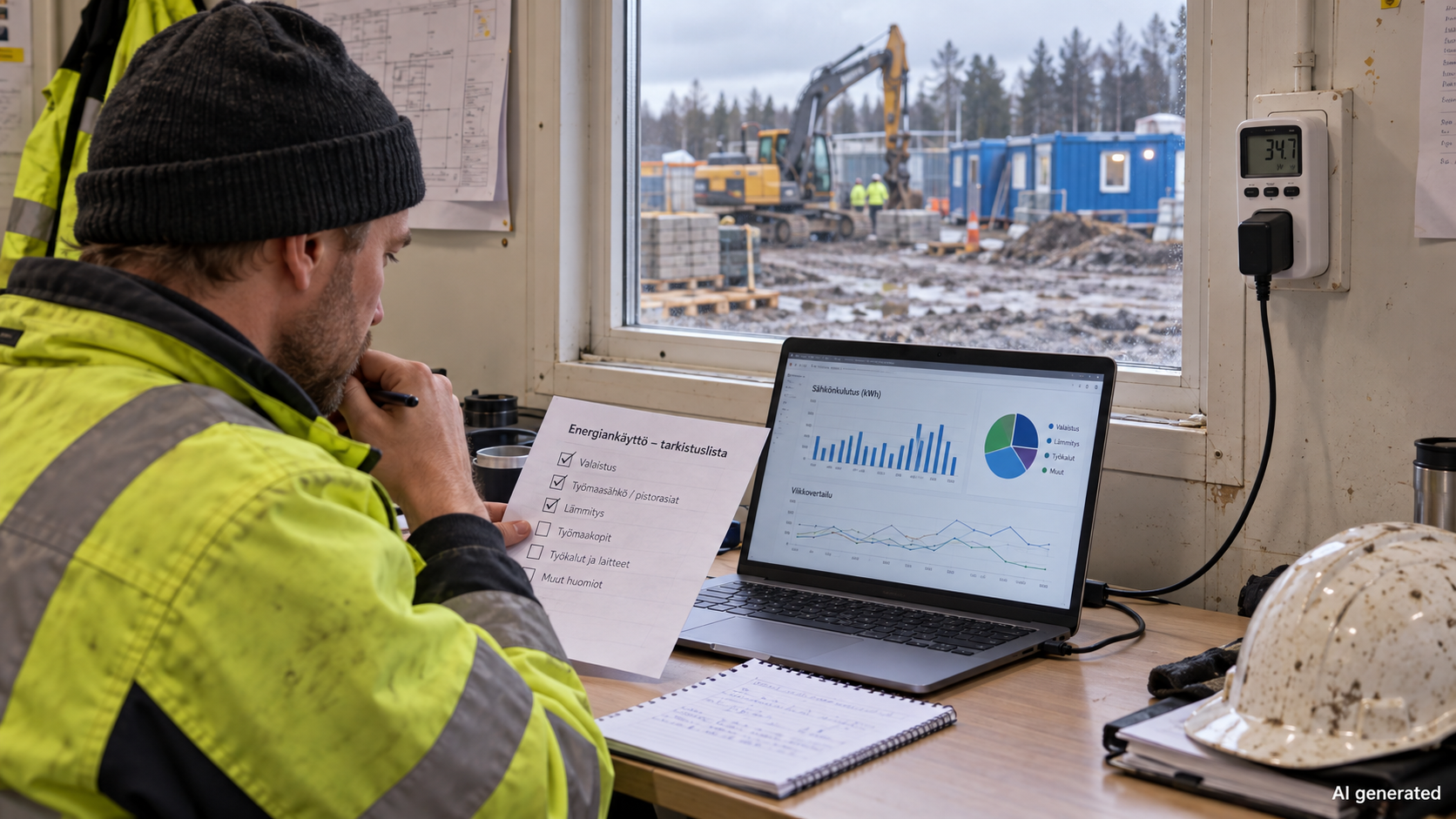
AI can help at work, but using it consumes energy. Training models and generating answers require computing power. The data centres that run the servers, and their cooling, also consume energy.
According to the International Energy Agency (IEA), the electricity consumption of data centres worldwide grew by 17 per cent in 2025. The figure covers all data centres, which serve other digital services as well as AI. IEA: Key Questions on Energy and AI.
A useful question in everyday work is: what does this use of AI actually achieve?
Beginner: learn how to use it first
If you are just starting to explore artificial intelligence, energy savings may not be the first thing you think about. Practice asking questions, try different tasks, and learn to check the answers. Even failure in practice can be a learning experience.
The first skills are safe data handling, giving a clear task and evaluating the result. Once you understand where artificial intelligence can help you, you can start developing its use more effectively. The following checklist is intended specifically for the user who is already familiar with basic usage.
The benefit comes from the work as a whole
AI can help you get an overview of a long report, compare options or prepare a recurring task. On a construction site, for example, it could pick out the open questions in a report for the next meeting. The result must still be checked against the original material.
Estimate the entire work phase: how much time is spent on providing instructions, correcting answers, and verifying data? A lightweight model that requires many corrections to the answer may not be the best choice for the task. A more capable model can sometimes produce a usable result in fewer attempts.
Saved working time does not automatically mean saved energy. The assessment of environmental benefits also requires information about what the use of artificial intelligence replaces.
Checklist for more energy-efficient AI use
- Do the things that are easy without AI without AI. Use a calculator for simple calculations, a spreadsheet for totals and the document search to find a word. Choose a familiar tool when it solves the task easily.
- Choose a model that suits the task. If you are unsure, ask the AI. Describe the task and the models available to you. For example, ask: ”Which of these is suitable for this task, and is a lighter model sufficient?” Use the answer as a guiding aid. Artificial intelligence may not be familiar with the latest models of the service or their actual energy consumption. Check the updated features in the service provider’s information.
- Compare language models with your own work tasks. Find out what each one is good at: summarising, writing in Finnish, interpreting documents or demanding reasoning. Try the same limited task with several models and evaluate the quality and the number of necessary corrections. Use public or fictitious data if not all services are approved for customer data processing. Comparison helps in model selection; it alone does not measure energy efficiency.
- Follow and test new, more energy-efficient models carefully. Engineering also leads to better results here: the structure of the models, calculations, and hardware are developed. However, a newer model does not automatically consume less energy. Check whether the efficiency has measurement data and whether the quality required for the task is maintained. Perform a limited test before making the change.
- Give the goal, the material, and the desired response format at once. Say what you need and how extensive it should be. For example, ask for five observations instead of rewriting the entire report. Provide essential material and the necessary context for the task; too little initial information can lead to additional rounds of questioning.
- Use deep reasoning and extensive searches when the task requires them. Formatting a short text and solving a multi-step technical problem need different handling. If the service lets you choose the level of reasoning or automatic work steps, match them to the difficulty of the task. Give automatic work a clear goal and a stopping condition.
- Fix only the part that needs fixing, and reuse ready-made templates. When there is one problem in the answer, ask to change that point. Save the working instructions, checklists, and approved texts for the next time you use them. You don't need to produce everything again.
- Produce alternatives and different content formats only as needed. First, ask for one usable version and add options if you need comparison. Use images and videos when they help to understand the message or are necessary for the final result.
- Stop when the result fulfills its purpose. Endless small rounds of polishing do not always add value. Decide in advance what a good enough, checked result looks like.
Energy consumption cannot be determined solely by speed or price
Consumption depends on factors such as model, task, response length, and hardware. Complex reasoning and automated multi-step tasks can increase the computational requirements. Technical developments also improve efficiency, although increased usage can also increase overall consumption. IEA: Key Questions on Energy and AI.
For example, AI Energy Score provides a comparison of the energy consumption of language models under standardized test conditions. The results should be viewed in conjunction with the task and measurement conditions: they do not directly indicate the consumption of each commercial service or your own query. AI Energy Score.
The tips on this checklist help reduce unnecessary use and align the tool with the task. Precise energy savings cannot be promised without measurement data. Nor does a faster response, a lower price, or a smaller model alone prove lower consumption.
Responsible use covers not only energy but also protecting data and checking results. First we learn to use AI well. As experience grows, we also learn to choose where, how and how much to use it.
Filed under