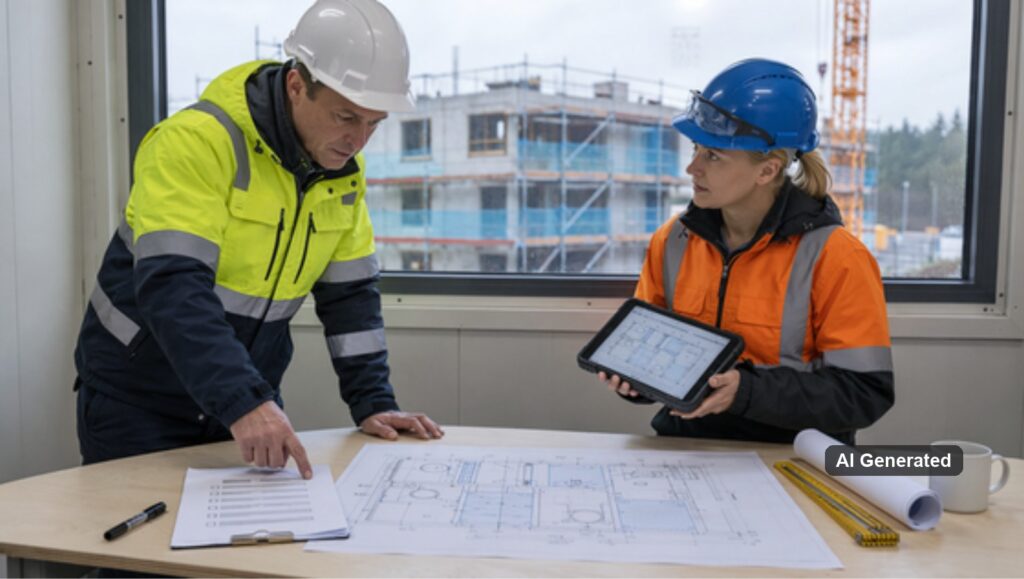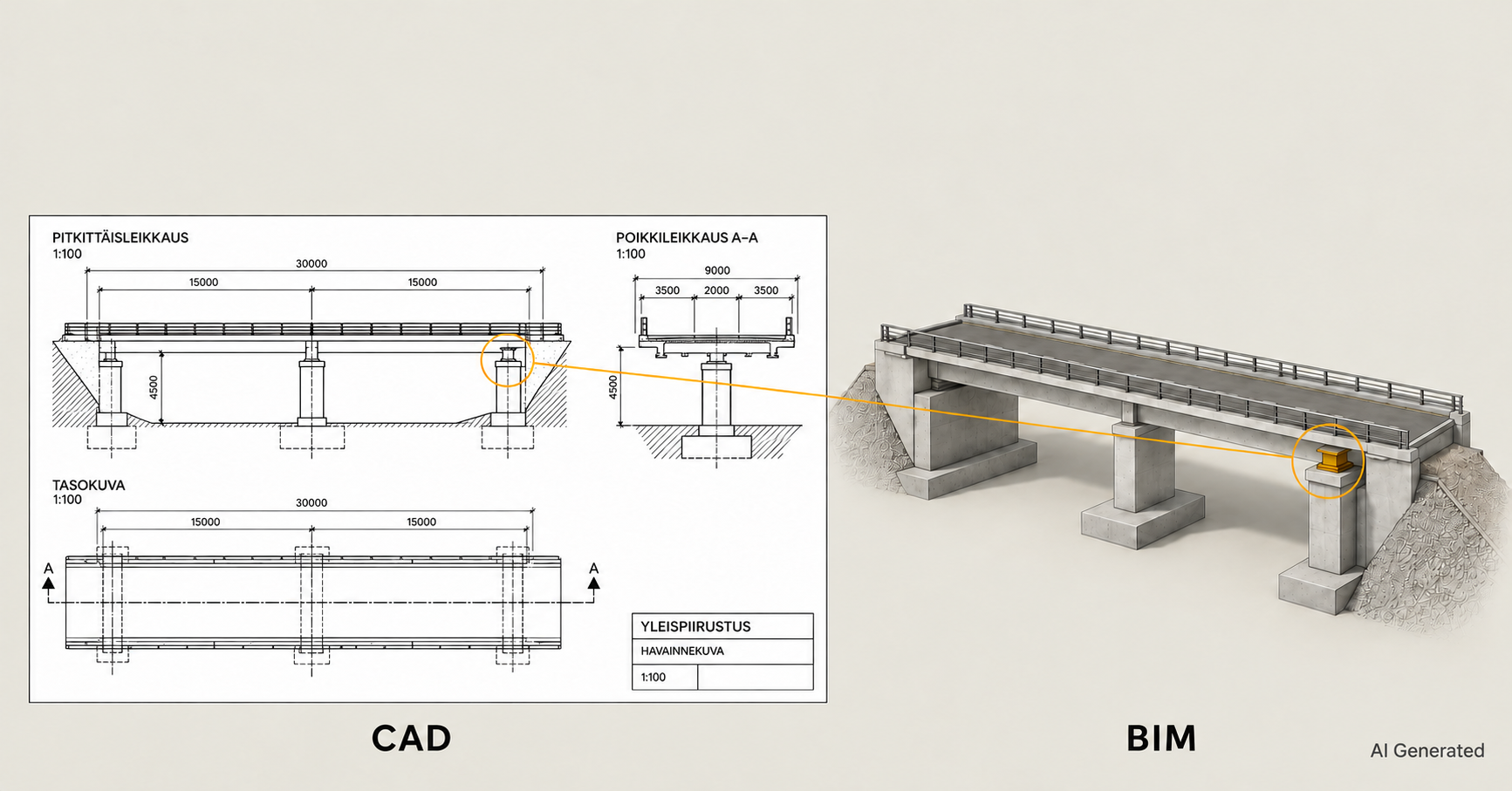
Quality assurance and cross-checking of design have long been among the most critical challenges in infrastructure construction and design technology. Different design disciplines use different file formats (such as DWG, IFC, STEP, RVT, NWD, and NWC), and manual coordination and quality control of these formats is slow and prone to human errors.
The pioneer of open compatibility, the Open Design Alliance (ODA), has introduced the ODA MCP Servers solution based on the ODA Platform, which combines artificial intelligence agents with CAD and BIM data without the need for separate export to another file format. The availability and file format-specific support of the features of the solution must be ensured for the version used.
How can ODA development kits and MCP technology be used in the further development of design quality assurance and automation?
1. Direct connection between the AI agent and the model – without the need for an original CAD or BIM software
Both original design software and non-dependent viewing and inspection software have been used to review the plans. ODA MCP Servers provides an artificial intelligence agent interface by placing the agent between the CAD or BIM data and the design.
- The position between the file and artificial intelligence: Artificial intelligence is not fed with the entire binary or a large text file; instead, it requests the geometry data, structural component properties, or quantities it needs from the MCP server.
- No addiction to the original program: According to ODA, the server reads supported DWG, IFC, and STEP files directly without the original CAD or BIM software used to create them, such as AutoCAD or Revit, being installed or running.
2. Deterministic calculation results – Artificial intelligence obtains measurements from the geometry of the model
One of the biggest risks of artificial intelligence in quality assurance has been erroneous estimates, or ”hallucinations”. ODA reduces numerical guesswork by combining the reasoning capabilities of artificial intelligence with the C++ geometric engine at the commercial level.
- Same math, same result: The calculation of volumes, areas, masses, free spaces, and distances is based on the geometry of the model and the calculation functions implemented with program code. Mass calculation also requires accurate material and density data.
- Measurement results from the model, not as language model evaluations: Artificial intelligence receives numerical data calculated from a model in response. This reduces guesswork, but does not guarantee the correctness of the entire verification: the starting model may be incomplete, and artificial intelligence may select incorrect items or interpret the result incorrectly.
3. Cross-checking between different design disciplines in one meeting
Infrastructure construction data may include, for example, IFC models for bridges, STEP models for equipment, and DWG files for street and utility engineering.
According to ODA specifications, MCP servers intended for different file formats can be used in parallel through a common geometry data structure and tool interface:
- An artificial intelligence agent can retrieve data from different files in the same session. Processing a single user request may require multiple tool calls.
- ODA also describes cross-format links that can be used to combine similar objects in different files. They can be used to develop, for example, a check to see whether a device in STEP format corresponds to the space allowances in an IFC or DWG model. The extent of the feature implementation must be verified based on the version used.
A reliable cross-check also requires, among other things, coordinating the coordinates, units, model versions, and the meanings of the objects.
4. Practical quality assurance surveys in automation
On top of the ODA MCP interfaces, artificial intelligence-assisted tools can be developed for routine checks. Examples of survey questions are:
- Disguising missing information: ”List all components that lack a material specification.”.
- Checking free spaces: ”Does this corridor or underpass height meet the requirement of the free space applied in the project?”
- Verification of data content and classifications: ”List all the fire doors that lack a fire classification label.”.
- Quantity calculation and verification: ”Calculate the amount of structural steel on the 3rd floor.”.
- Automatic entries: Within the limits of the available tools and file format and version-specific support, artificial intelligence can add computational results or insights to the model's features. Support for creating measurement markings must also be ensured for the implementation to be used.
Checking compliance requires that applicable requirements, verification rules, and necessary input data have been defined. Example questionnaires do not, by themselves, indicate a ready-made compliance verification solution or a specific time savings.
5. Local use and data security in critical infrastructure
Public sector and critical infrastructure planning often includes sensitive information that cannot be transferred to open cloud services.
- STDIO local space: The ODA MCP Server can be run locally in conjunction with a local language model. When the entire processing chain is implemented locally and network connections are properly managed, the plans and the data extracted from them can be kept within the organization’s own environment. The STDIO connection does not mean an isolated entity from the network; it is not an air-gapped entity.
- Controlled file access: Allowed folders can be restricted for the server to handle, and each function is marked either read-only or also writable.
A local MCP server alone does not guarantee that data remains within the organization. If an agent uses a cloud-based language model, the data extracted from the model can be transferred for processing even if the original files remain local. Security and suitability for critical infrastructure must be evaluated based on the entire implementation.
Summary: Towards quality assurance in artificial intelligence-assisted design
Development kits and the open MCP standard that support different file formats create the foundation for future quality assurance systems.
As the self-dissemination and quality assurance of design are developed further, the ODA MCP interfaces provide the technical foundation for AI-assisted inspections. They allow for the retrieval of information from plans and the construction of inspections where data is compared against specific defined requirements. The goal is to help detect errors before construction begins. This requires suitable inspection tools, high-quality input data, and ensuring the functionality of the inspections in practice.
What is the Open Design Alliance (ODA)?
Open Design Alliance (ODA) is a member-driven, independent organization that has been developing technology drivers for engineering data and CAD and BIM software for over 25 years. Its network includes more than 1,200 member organizations worldwide.
ODA offers software development kits (SDKs) that support the reading, editing, and management of files from various design disciplines—such as DWG, DGN, IFC, and STEP files, as well as Reviti’s RVT and RFA files and Navisworks’ NWD and NWC files—within the limits of file format and version-specific support without using the original design software. ODA MCP Servers technology extends this compatibility to the era of artificial intelligence by connecting artificial intelligence agents to engineering data through the open Model Context Protocol (MCP) standard. The MCP server may not support all the same file formats and functions as ODA’s other tools.
Filed under