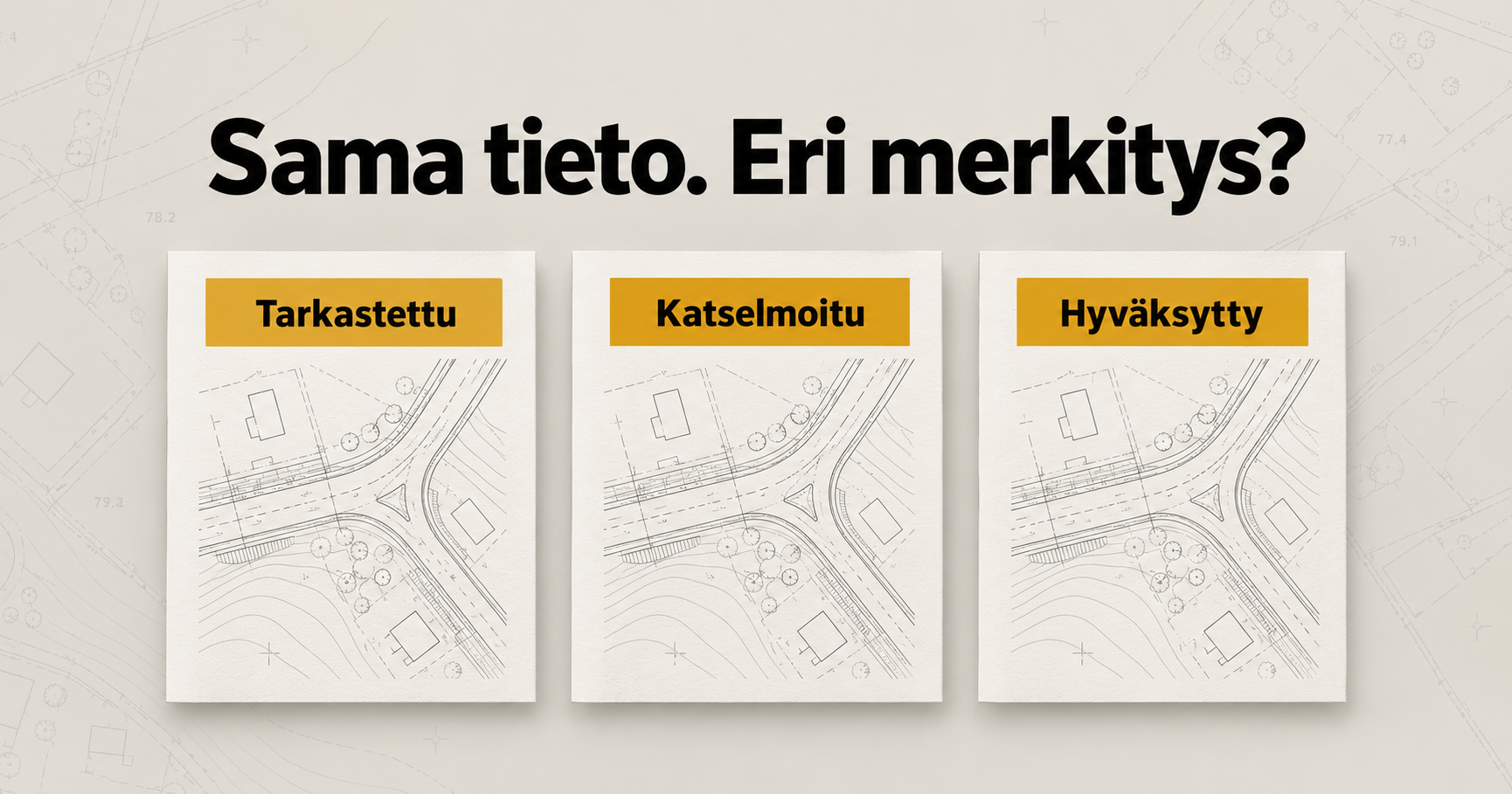
Do the inspected, surveyed and approved mean the same thing?
When talking about the quality of data, attention easily turns to missing information, erroneous numbers, or outdated data. In practice, however, the quality of data begins much earlier: from the fact that, how things are defined and with what terms they are discussed.
If different terms are used for the same subject matter, or the same term means different things to different people, ambiguity easily transfers to systems, reporting, and automation as well. In construction and infrastructure projects, this is especially pronounced because information is produced and used by many different parties throughout the project lifecycle. At the same time, the information should retain its meaning from planning to construction and later maintenance.
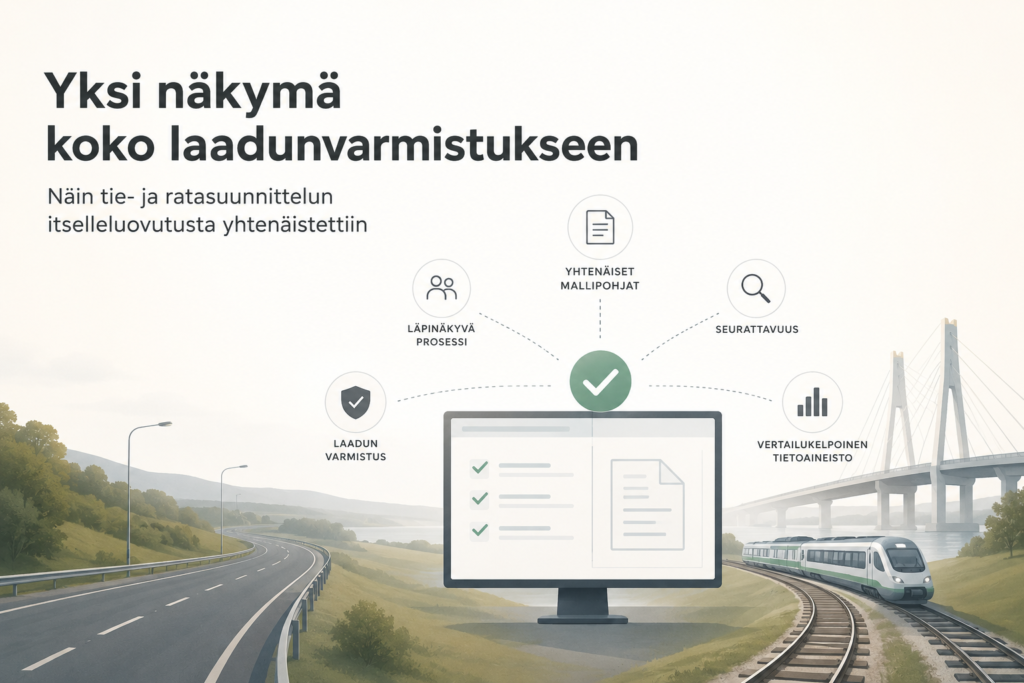
In 2024-2026, we went through the road and rail design self-disclosure process in the Väylävirasto workshops. The goal was to build a common Excel model that would allow the quality assurance, corrections, and approvals of the design data to be visible in the same way in different projects.
Quite quickly, a question came in that sounds small but isn’t: what exactly should be said in the different stages? The material might have been reviewed, examined, received, or approved. However, based on the words, it wasn’t always possible to conclude what had been done with the material, who had made the decision, and whether the process could continue to the next stage.
The same word can mean a different decision
In a single system, the state of the data can be reviewed, in the other watched and the third approved. If this information is combined with the report, the system does not know whether the terms describe the same phase or three different events. It also does not know artificial intelligence unless the meanings of the terms and the relationships between them have been defined first.
Also Reception can mean several things. It can be a confirmation of the arrival of the material, an internal review by the client, or a decision based on the agreement to approve the work. Conversely approval It can mean technical approval, permission to proceed to the next stage, an official decision, or, for example, approval related to the final payment instalment.
It is therefore not just a matter of choice of words. The terms are based on the process stages, responsibilities, decisions, and the information that arises from them. If the meanings remain unclear, the information about the progress of the process also remains unclear.
In construction, the thermal layer is growing rapidly
In the construction and infrastructure processes, many parallel concepts are used. We talk, for example, about self-disclosure, phase inspection, review, supervision, acceptance inspection, inspection documentation, commissioning inspection, final inspection, and acceptance of the project. In planning, for example, input data, input data, and input information are mixed in the language and differ from the guidelines in the General Infrastructure Requirements.
The terms are not interchangeable, although they may be used in everyday language side by side. The final review by the authority and the acceptance of the work by the client are different events with different purposes, author, and legal significance. Also, verification, inspection, and approval may be placed at different points in the process.
The problem becomes apparent at the latest when information needs to be combined from different projects, organizations, or systems. One service provider reports the data as reviewed, another as ready, and a third as approved. A common picture emerges only if we know what each term means in practice.
The Road Administration is unifying the concepts of transport infrastructure
For several years, the Ministry of the Environment and the Finnish Transport Agency have been working on unifying the terminology of transport infrastructure. In the first phase in 2024, a comprehensive glossary of 100 terms was published. In the second phase, carried out between 2025 and 2026, the glossary was updated and expanded with approximately 50 new terms.
News published by the Highway Authority in August 2026 According to the work, the goal is to standardize concepts related to traffic, traffic routes, and access to areas, and to improve the interoperability of information. The vocabulary defines recommended terms, their synonyms, differences between concepts, and Swedish and English equivalents.
In the work, it is recommended, for example, to use the term Basic cross-section, which is synonymous with type cross-sectional cut. The term General plan of the railway It is recommended to use the term General plan of the track Instead. Furthermore, the concepts have been separated from each other. drum yes drum tube, which in everyday speech can easily mean the same thing.
The vocabulary is also not intended to be a separate publication. According to the Road Administration, the concepts and terminology recommendations will be incorporated into guidelines, information systems, and expert work. Artificial intelligence will also be used in the implementation process, as the concepts in the vocabulary are aligned with existing guidelines.
Whole You can learn about the terminology of transport infrastructure on the Interoperability Platform. Concepts related to the design and construction processes are also found From the road naming convention.
The vocabulary does not change into a common way of doing things by itself.
The terminology work of the Finnish Transport Agency is also interesting in its implementation method. In addition to the Finnish Transport Agency and the Ministry of the Environment, experts from the public sector and planning agencies, as well as terminologists from the Finnish Language Centre participated in the work. 94 comments were received on the draft, which were discussed in expert workshops before finalizing the terminology.
Vocabulary cannot be built by simply collecting words into Excel. First, we need to understand the relationships between concepts, the ways different actors use them, and where the term is used in the process. Then, we need to take common terms and translate them into instructions, systems, forms, and people’s everyday lives.
The same principle is also seen Recommendations regarding standardization of information modeling in buildingSMART Finland. At the beginning of the project, it is necessary to identify the key terms and their possible synonyms. The purpose of terminology is to help different parties understand in the same way what is being done in the project and how the work relates to other information management processes.
What did we actually do in the self-disclosure model?
In the self-disclosure model of road and rail design, we did not try to solve the entire infrastructure terminology at once. We went through a limited process and combined the terminology used with what was actually happening at that stage.
In connection with each phase, for example, it was filmed:
- Term: Which phase or event is being depicted?
- Author: Who checks, verifies or approves?
- Target: What material or plan is being discussed?
- Evidence: What entry, document or receipt is generated from the stage?
- Corrections: What happens if deficiencies are found in the material?
- Next status: Can the process be continued or will the material have to be returned for correction?
- Comments from the field: First of all, we checked with the people who did the design work to make sure that the direction was correct.
When the term was combined with the subject, the object, the evidence, and the next step, the discussion changed. No longer was it just a matter of which word sounded right, but what was really happening in the process. The model did not resolve all the concepts, but it made the responsibilities and the progression of the material more visible.
First information and process, then technology
The new system does not correct an unclear operating model. If the same events are used with different terms in the old instructions, forms, and systems, the new system only transfers the ambiguity to a new interface. At worst, the menu looks neat, but no one still knows what the selected mode actually means in practice.
Therefore, the first step can be very simple. We collect the key terms of one process from actual instructions, forms, reports, and systems. Then we identify the parallel terms, select the primary term, and determine to which event, responsibility, and process state it relates.
Once this logic is common, it can be used to build system menus, automatic notifications, reporting, and transferring information to the next stage. Only then does digitalization truly begin to clarify operations.
Good data also forms the foundation for artificial intelligence
Artificial intelligence increases the need for understandable and consistent information. If reviewed, watched yes approved They can mean either the same thing or something different; artificial intelligence cannot classify data or form a reliable situational picture without organizational-specific definition.
The real problem is not the ability of artificial intelligence. The problem is that the meanings of the process have not been defined precisely enough for humans, systems, or artificial intelligence. A more effective approach is to first define a common language, then connect it to the process, and only then automate the processing of the data.
If the terminology of your own organization seems too overwhelming for a project, start with one limited process. Pick three words that are used differently in the instructions and systems, and write under them the author, decision, evidence, and next step. This will quickly show whether the problem is in the data or already in the common language.
Clarifying one process also helps identify where artificial intelligence could be useful. Once we know what stage of the process is being done and what kind of information is needed, we can assess what should be automated and what requires first fixing the workflow. In the following article, I will go through how to choose the first AI development project that solves a recognizable everyday problem.
Filed under