In many organizations, there is currently a feverish discussion about how to advance the utilization of artificial intelligence and move towards what is called the "fourth industrial revolution." from step one to step two.
At this stage, some employees have already started using general artificial intelligence tools such as ChatGPT or Microsoft 365 Copilot in their daily work. Artificial intelligence is used at the individual level to draft emails, summarize texts, brainstorm ideas, or quickly search for information. This is an excellent start, but it is only a trial phase.
When an organization wants to move to step two, that is, start developing structural artificial intelligence solutions, automated workflows, and autonomous artificial intelligence agents, the first and perhaps most critical question arises: Which development area should we start with?
It is not possible and not advisable to change all the processes of an entire organization at once. Too large a development project often ends in complexity, lack of resources, or resistance to change. The key to success lies in how the first AI development target is identified, classified, and selected in a controlled manner.
In this article, we will go through the selection of the first AI development target using a clear and practical approach, explain key terminology, utilize Microsoft’s four-field diagram, and provide an overview of what happens after the selection.
Getting the terminology right: What does ”mapping” mean in Finnish?
In AI and development projects, we constantly encounter the English-language word mapping (for example use case mapping or Workflow mappingWhen talking about development and process reform, English legal terms often appear in the conversation. However, it is useful to clarify what the term means exactly in Finnish:
- Mapping or mapping: By this, we mean the comprehensive exploration and making visible of the current state, ideas, or possibilities within an organization. It answers the question: what are we already doing and what needs do we have?
- Classification or grouping: Sorting of data, processes or usage patterns according to certain predefined categories.
- Investment in the four-field: A visual and strategic process in which use cases are placed on a two-dimensional matrix based on the selected criteria.
- Packing or mucking: A commonly used professional jargon in information technology and project management that expresses the combination of two different levels of abstraction (for example, the combination of a work phase with a specific AI role).
In this article, we use the terms usage cases fluently. mapping, classification and mapping to a four-field layout.
1. Map the current situation with a survey of employees
The first step in selecting a development area should not be based on guessing in the boardroom or reading sales brochures about technology platforms alone. The best information about your organization's real needs, bottlenecks, and untapped AI potential can be found from the experts and employees who work every day.
Finding the development area starts with a light organizational survey and interviews. Ask employees and experts the following three questions:
- How and where do you currently use artificial intelligence in your everyday life? (Identify existing experiments and tacit knowledge.)
- Which routine tasks take the most time or feel exhausting? (Identify the potential for automation.)
- In which stages of the workflow do information searches, summary reports, or quality assurance cause the most delays? (Identify the performance boundaries of the business.)
Thanks to the survey, you will be able to compile a huge number of real-life use cases for the raw material (multiple cases). After that, the next step begins: organizing and analyzing the material.
2. Case studies for Microsoft's four-field approach
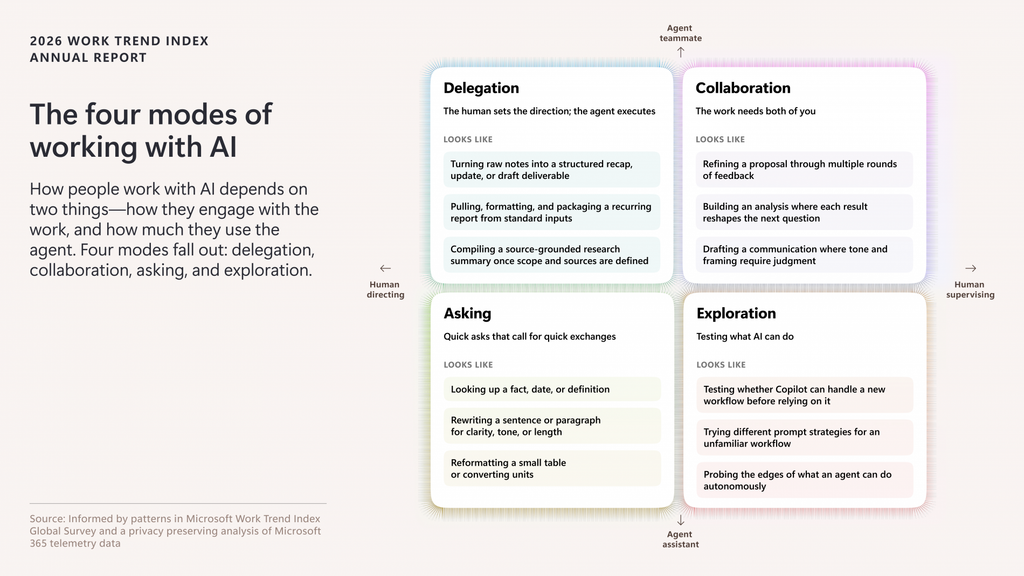
Once the survey responses and experiments have been compiled, they are classified and summarized. The four-field model based on Microsoft's Work Trend Index study. This diagram helps the organization to understand what kind of artificial intelligence and human work distribution is involved in each use case.
The four-field approach is based on two key axes:
- Perceptual axis (Artificial intelligence autonomy): Varies from low to high on the scale Agent assists (Agent assistant) vs. Agent as a colleague (Agent teammate).
- Horizontal axis (Human role): Varies from left to right on a scale Human directing vs. Human supervision (Human supervising).
The four categories of the field of play and practical examples
The four quadrants of the grid represent different forms of collaboration between artificial intelligence and humans. You can categorize your organization's use cases into these categories:
1. Delegation (Delegation) – Top left
- Axles: Agent as a colleague + Human directing
- Description: Tasks in which artificial intelligence performs entire workflows or task groups independently within the framework of instructions and guidelines provided by humans.
- Practical example: When a new Finnish-language blog post is published on the website, the AI agent behind it automatically translates it into English, formats the text and publishes it in the English section.
2. Collaboration (Collaboration) – The right upper corner
- Axles: Agent as a colleague + Human supervising
- Description: Artificial intelligence and humans work in close interaction with the robot. The artificial intelligence performs heavy reasoning or analysis, and the human acts as a sparring partner, a guide, and a quality controller.
- Practical example: AI-assisted expert interview when writing a blog post. The expert says that he/she wants to create an article about a specific topic in the length of about 1,500 words. The AI acts as an interviewer, asking the expert a question at a time and forms a structured draft based on the conversation for further work on the Word document.
3. Asking – Left bottom corner
- Axles: Agent assists + Human directs (Human directing)
- Description: Fast and precise question-and-answer situations where a person seeks advice, code, or instructions from artificial intelligence for a specific problem.
- Practical example: The expert asks ChatGPT or Copilot for advice on building a complex Excel formula or finds a specific software setting.
4. Exploration – The right angle
- Axles: Agent assists + Human supervises (Human supervising)
- Description: The use of artificial intelligence to maintain situational awareness, monitor information, conduct background mapping, and summarize data sets.
- Practical example: On Monday mornings, artificial intelligence compiles and summarizes into an automated summary in email what has happened on the artificial intelligence front in its own industry (such as the infrastructure sector or digital regulation) over the past week.
3. Choose the first development area using decision matrices
Once all of your organization's identified use cases have been grouped into Microsoft's four quadrants, you have a strategic choice ahead of you: From which of these should we start to build the first real AI development project?
This choice is supported by Impactfulness and The feasibility -quadrangle (Impact vs. Feasibility Matrix that is to say Value vs. Effort Matrix). It is an easy and visual decision-making method.
High ^
        [STRATEGIC PROJECTS] [EASY PROFITS / QUICK WINS]
        |Great impact | Great impact
        | Challenging to implement | EASIEST TO IMPLEMENT
        Low IMPLEMENTABILITY / HIGH RISK
The golden rule of the first development objective
The focus is on the tasks where The AI acts as an assistant or a team member and the human supervises (Human supervising) – namely especially Collaboration -use cases of the field.
Choose from these options the lightest possible use case, which is located in the decision-making matrix Easy wins (Quick Wins) -in the group.
Why exactly the lightest possible use case?
Many organizations make the mistake of choosing the most critical and complex process in the business as the first AI project. This easily leads to long development cycles, high costs, and frustration.
Choosing the lightest use case is justified for the following reasons:
- Learning and experience: The team learns the principles of artificial intelligence development, agent prompting, and interfaces in a safe environment.
- Fast and visible results: When the first solution is brought to production within a few weeks, it immediately demonstrates the benefits of artificial intelligence for the entire organization.
- Lower risk level: When a person acts as a giver and a supervisor (human-in-the-loop), avoiding possible quality and safety risks.
What happens after the selection? The next three steps
Locking down the first development area is an important milestone, but it is only the beginning. Once the lightest development area has been selected and the agent features are started to be planned, the development work continues in the next three key phases:
1. Development of the risk matrix
Before coding or broader exploitation of the solution for the development project, a detailed risk matrix is prepared. This assesses, among other things, the risks related to data security, business secrets, intellectual property rights, and artificial intelligence errors (hallucinations), and defines methods for managing them.
2. Budgeting and the artificial intelligence economy
In artificial intelligence development, the cost structure differs from traditional software. It is important to understand the new artificial intelligence economy: how the ongoing costs of the development project arise from language model tokens, platform credits, and potential API interface fees as usage volume increases.
3. Measuring effectiveness
Clear metrics are set for the development project (KPIs): How much do we save in expert working time? How much does the process throughput speed up? Does the final result’s quality or employee experience improve? Measuring ensures that the experiment provides longer-lasting evidence for further investments.
Summary
The transition from phase 1 to phase 2 of AI adoption requires a clear structural approach alongside the experimentation culture. When you start with a baseline survey by listening to employees, you classify the experiments within Microsoft’s four quadrants and, using the decision-making matrix, select the simplest possible collaborative use case for your project, ensuring the best possible starting point for your project.
The first successful AI development project paves the way for the next ones and shows the entire organization how to shape AI into real and measurable business value.
Finally, watch the video below, where I walk through the four quadrants using practical examples. At the same time, mirror one of your own organization's work tasks on the model: what would artificial intelligence do and what would a human do?
Once the first development area is defined, a realistic budget is also needed to implement it. In addition to the initial costs, it is necessary to estimate what the usage, maintenance, and human inspection costs will be in everyday life. In the next article, ”The real cost of artificial intelligence, part 2,” I will discuss artificial intelligence project budgeting and AI FinOps, i.e., how to monitor and manage the costs of artificial intelligence during its use.
Filed under