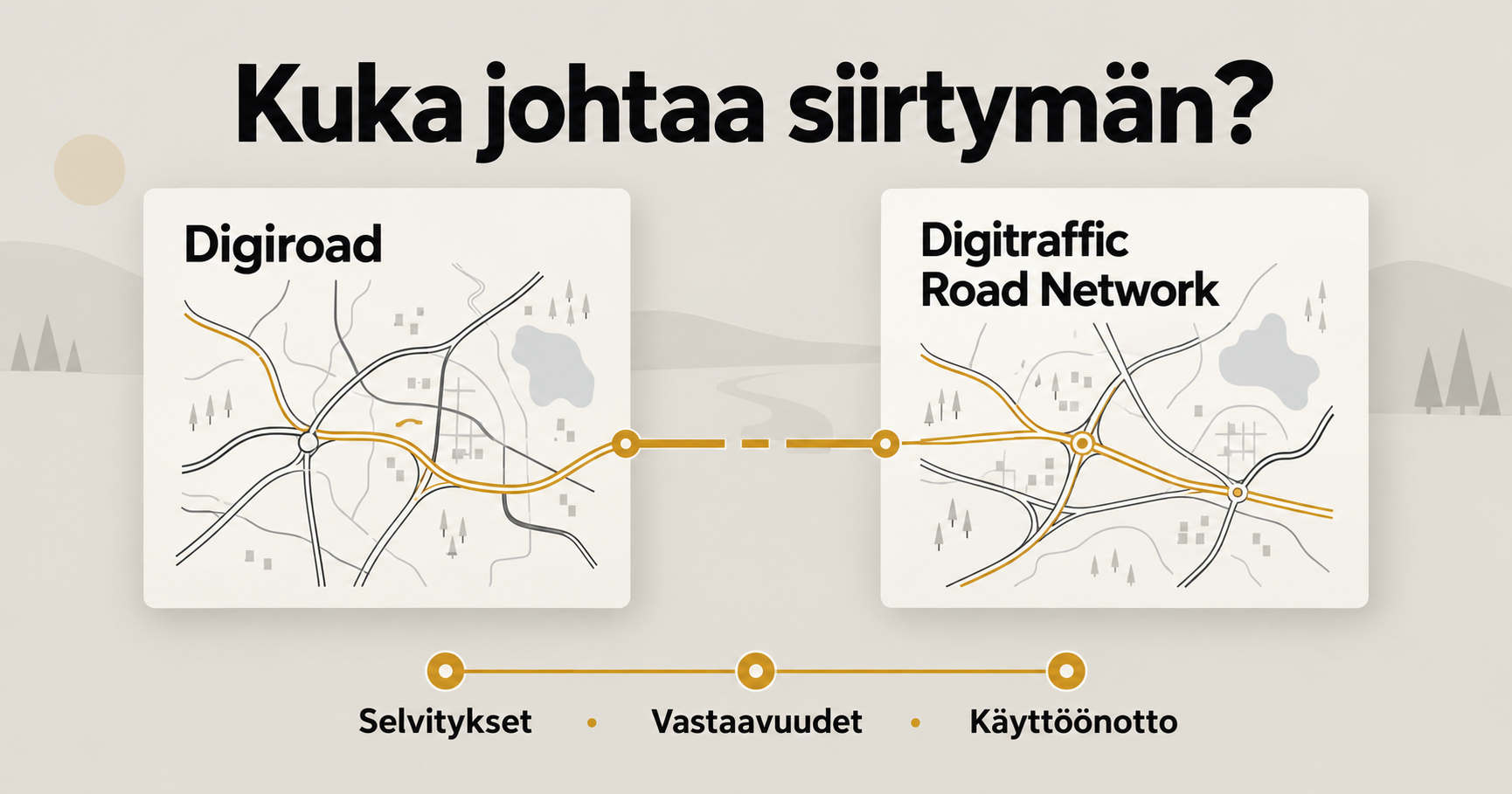
The change in the information service can appear to the outside world as a technological update. The old service is closed down, a new one is opened, and a new address is provided to the users. In practice, the change can extend beyond the systems to the project schedules, the supplier agreements, the people’s tasks, and how information is transferred from the organization to another.
The renewal of Digiroad is a timely example of this. When a familiar information service is replaced by a new one, and at the same time, data models and interfaces change, the organization must determine what the change means for its own operations. Simply waiting for the new service to be completed is not yet ready for deployment.
From a management perspective, the most important question is this: who brings the effects of change together and ensures that the transition takes place in a controlled manner? The service provider is responsible for its own reform. Organizations that utilize information must, in turn, lead the change in their own systems, projects, and practices.
What will change in Digiroad?
Digiroad was transferred from the Finnish Transport Agency to Fintraffic at the beginning of 2026. According to Fintraffic’s press release, the update of the data to the current service ended on 31 August 2026, and the service will be closed at the end of September. After this, a downtime of at least the rest of the year will begin, during which no new material publications will be produced.
The replacement Digitraffic Road Network will be introduced gradually in 2027. The reform includes data models, applications, and interfaces for data delivery and publication. The goal is to publish data according to the first new data model in the spring of 2027. The current status can be found here From Fintraffic's change announcement.
For the organization, it is therefore a transition in which the end of the old service and the introduction of the new do not occur at the same time. This must be taken into account both in ongoing projects and in preparing for future work. The target timeline for the new service is the starting point for planning, alongside which an own action plan for the interim phase is needed.
First clarification: where are we dependent on the current service?
The extent of the change is difficult to assess if the current usage is not known. Digiroad can appear in one team as downloadable material, in another as part of the software background, and in a third as part of the work of an external service provider. Not all dependencies can be found in the system catalog or in the memory of a single person.
I would therefore start with an overview of the current situation. In which projects and services is information used, how is it made available, and who is responsible for the practical work? At the same time, it is necessary to determine whether the data is transferred manually, through the organization’s own integration, or implemented by a software provider.
At this stage, the management’s task is to bring the right people together around the same table. The information user knows the daily needs, the technical expert understands the system dependencies, and the project manager oversees the project schedule. The procurement or contract manager, in turn, determines what remodeling work has been agreed upon with the contractor. These elements form a common picture of the magnitude of the change within the organization.
The similarities between the old and the new need to be mapped out
One of the key tasks of the transition is mapping between the old and new services, or the mapping of equivalences. By this I mean here both the comparison of data and the comparison of operating practices. What do we currently use, where will the corresponding data be obtained in the future, and what will change in the processing of it?
The mapping should go beyond simply comparing the names of the fields. Things that can be investigated include the meanings of the data, identifiers, classifications, distribution methods, access rights, and update policies. The correlation between these should not be assumed in advance; instead, technical and industry experts must determine it based on the documentation of the new service.
The project manager does not have to personally resolve the details of the data models. However, he or she must ensure that the study has the right elements, a timeline, and a clear conclusion. There needs to be a visible distinction between what can be retained and what requires change, and what still lacks sufficient information.
Not everything can be resolved immediately. Open questions are worth compiling into a common list and naming the responsible persons for them. Otherwise, the same uncertainty will keep recurring in the meetings week after week without anyone taking responsibility for resolving it.
The ongoing project does not move to a new service with a single decision
Switching services and transitioning a project to a new service are two different things. The project may already have completed analyses, agreed deliverables, existing materials and systems that are based on the current solution. Changing them in the middle of the work can affect the schedule, costs and responsibilities of the different parties.
Therefore, the ongoing projects should be considered separately. The situation of a project nearing completion may be different from that of a multi-year project or work just starting. It is not advisable to decide on a transition method for everyone without first examining the implications.
Controlling issues include, for example, the timing of the transition, the necessary changes, and decision-making. Who assesses the options, who approves the course of action, and how is it agreed upon with the client and other parties? If the decision affects the agreed delivery, the matter must also be addressed in project change management.
The intermediate phase needs its own operating model
A downtime makes a phase that easily goes unnoticed in system updates visible. The organization’s daily routine continues, even though the replacement service is not yet fully available. Work must be planned, contracts prepared, and customers informed about the conditions under which tasks can be carried out.
The interim plan should describe the available services and materials, as well as the needs for which a confirmed solution has not yet been determined. Experts assess the suitability of the options. The project management team compiles their impacts into a timeline, resources, and deliverables.
Temporary operating methods also need an owner and a termination condition. Otherwise, a procedure agreed upon in haste could become a permanent practice alongside a new service. The reform is only partially complete if the new solution is in use but the old routines continue to exist.
Responsibilities, editors, and costs must be made visible
The transition usually involves several parties, each responsible for only part of the overall process. The national service provider develops the service, the software provider modifies its own product, and the data user prepares for the new way of working. The project sponsor and service provider still have to agree on how to take these changes into account in the joint work.
The problem easily arises between the parties. One is waiting for a boundary description, another for a request for modification work, and the third for information on when the users should be trained. Everyone can do their own job, even if the progress of the whole project stops.
Therefore, in addition to the responsibilities, it is necessary to identify dependencies. What information or decision does each person need before they can proceed? At the same time, it is worth checking which changes are included in existing agreements and what additional work will be required.
Budgeting also requires time for your own staff. Investigating the current situation, mapping out the connections, testing, updating the instructions, and supporting the users do not happen without effort. If these tasks are left to be handled alongside other work, the transition schedule is easily based on capacity that does not actually exist.
The readiness to put it into operation must be demonstrated in practice
Technical connection to the new service is one of the prerequisites for implementation. In addition, it is necessary to ensure that the workflow required by the organization works and that people know how to act after the change. Access rights, support channels, responsibilities, and updated instructions are all part of the same package.
A limited pilot can help determine what implementation in reality requires. It is worth choosing a recognizable work task for this and agreeing in advance what the experiment is intended to determine. It is the responsibility of technical and industry experts to define the approval criteria for their own area.
The project management team, in turn, ensures that the findings from the test lead to decisions. What shortcomings prevent implementation, what can be corrected later, and who approves the remaining restrictions? The trial only helps when, based on its results, the plan is modified or progress is confirmed.
Here we need a change of owner
Such a transition is a natural example of a task where a temporary implementation or change manager can be useful. The organization may have all the necessary expertise, but no one has the time to lead the entire process alongside their own work. In that case, the problem is in organizing responsibility and work time.
The role of the interim manager would be to gather a situational picture, advance the work, and ensure the progress of decisions. He or she would combine the findings of the experts with the needs of the projects, the timelines of the journalists, and the decision-making of the management. The technical and planning evaluation would remain the responsibility of the experts who carry it out.
In the renewal of Digiroad, the most interesting management question is ultimately a very practical one: does the organization know how to transition from its current way of operating to the new one? If the answer is still unclear, the first task is to appoint an owner for the change and initiate the necessary investigations. These can be done even before all the details of the new service are ready.
In the following article, I will examine common terminology. When comparing information and practices, it is first necessary to understand whether the different parties mean the same thing with the same words. This is also the foundation for a successful similarity mapping and implementation.
Filed under