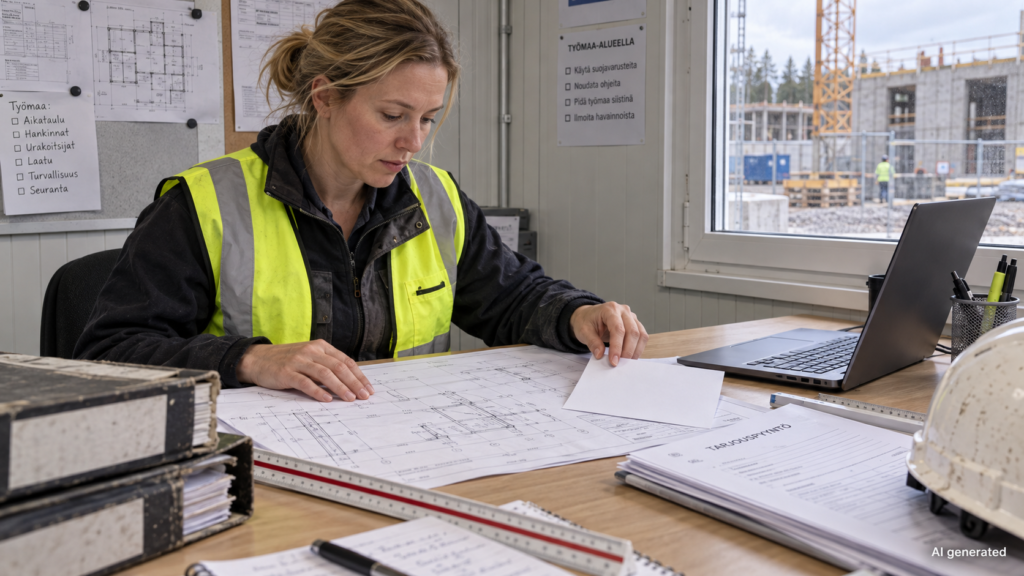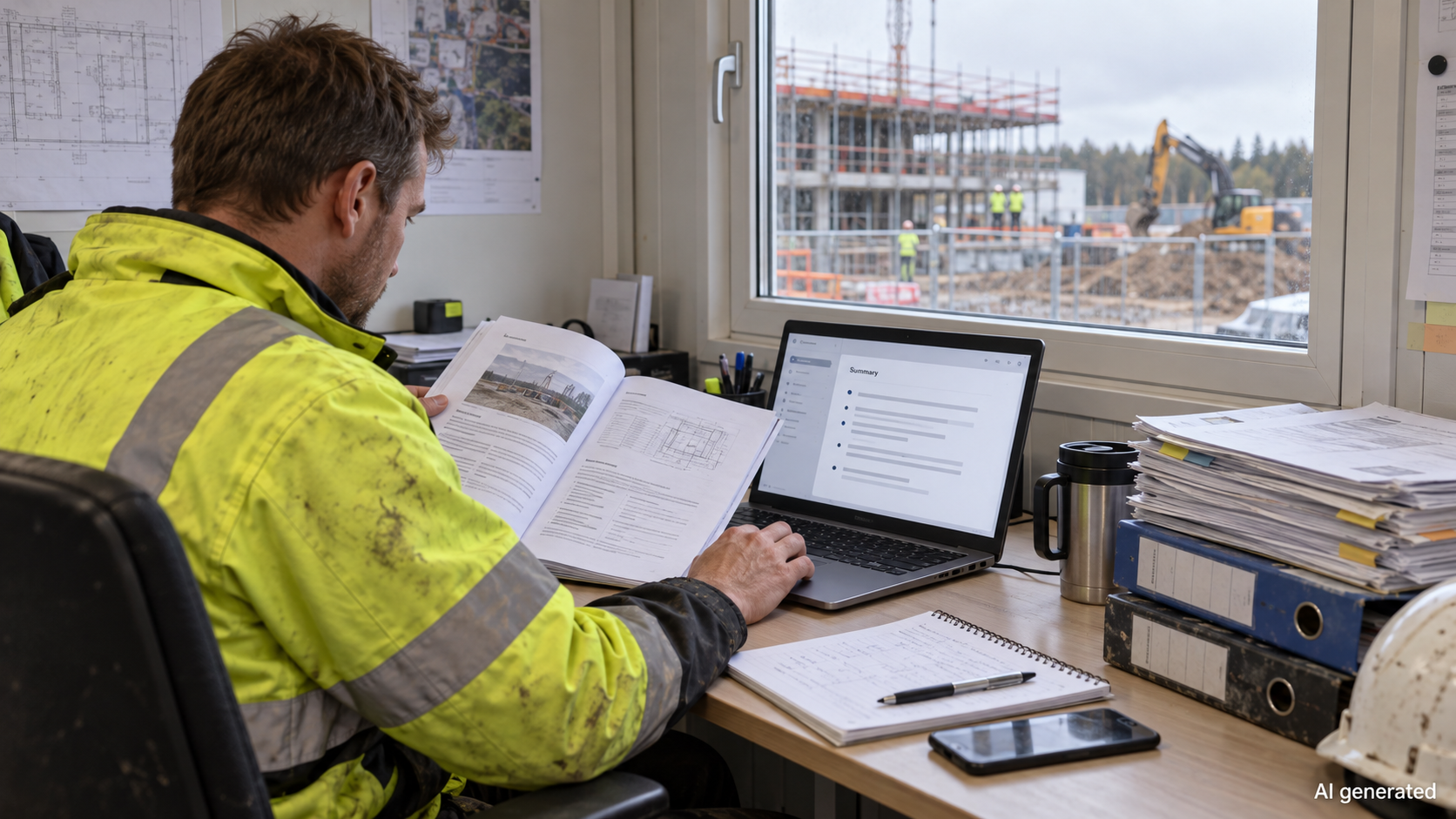
The 100-page report is waiting to be read, but the next site meeting starts in an hour. Where should I start? Artificial intelligence can help form a holistic picture and find the points that require attention. The benefits on the site can increase when other materials are added to the one report.
The plans describe what should be done. Timetables tell when it should be done. Work schedules, hourly records, inspection protocols, and meeting notes from work site meetings help to visualize what has happened. By comparing these, connections that are difficult to see from an individual document can be found.
First, tell me what you want to find out
Just saying “summarise this” easily produces a generic summary. Tell the AI your own perspective: are you looking for schedule risks, cost deviations, or next week’s decisions?
For example, you could use something like this as a guideline:
Read this report from the perspective of the site manager. Highlight five key observations, issues affecting costs and schedule, and questions requiring a decision. Mark the page or chapter name next to each observation. Use only the information in the report and let me know if anything remains unclear.
Before uploading the data, make sure the service is approved for processing. Drawings, RFQs, and employee shift schedules containing personal data are not automatically included in all AI services. Simply provide the information necessary for the task.
Combine the materials to create a picture of the work site situation
You can provide AI with approved plans, schedules, work rosters, hourly records, inspection documents, meeting minutes from job sites, calculation of quantities, and delivery information for processing. Request a summary of these for the exact question you are solving.
For example, for work next week, you can ask to compare the schedule, available employees, material deliveries, and open inspections. Which work steps are ready to begin? What is missing in terms of material, previous work, or the necessary approval?
Provide the dates and versions of the materials, as well as what plan or schedule is considered current. Ask the AI to highlight any discrepancies. An old meeting memo and an updated schedule can otherwise lead to confusion.
Compare these datasets and make a summary of the situation for the next week. List the initial work phases, their prerequisites, missing information, and issues to be resolved. Mark each observation with its source. Distinguish the fact found in the dataset from your own conclusion.
When hourly work and hourly records do not match
If there is a discrepancy between time recording, recorded work hours, or the progress of the work, artificial intelligence can help narrow down what should be investigated. For comparison, you can take, for example, time sheets, time records, the work site diary, delivery information, and meeting notes from the same period.
Has the work group been waiting for a load, a lift, or a supervisor’s visit? Has the previous work phase been completed? Or is it a different method of recording, a wrong work number, or an omission in the marking?
Compare this week’s hourly work lists and time sheets to the work site diary and the delivery information. List any discrepancies daily and by work phase. Look for possible explanations in the documentation. Do not assume the waiting time is solely due to the hourly work. Please tell us what additional information is needed to confirm the matter.
Artificial intelligence cannot know an undocumented event. If there is no record of the wait, it must be verified by employees or the work management. A discrepancy is the starting point of the investigation, not yet proof of the error or its cause.
When the construction site is flooded with materials
You can also view the material flow using multiple datasets. Give the AI an up-to-date schedule, the warehouse status of the work site, the delivery list, and the required quantities. Ask it to compare them with the actual progress of the work phases.
What materials will be needed in the coming days? What loads are related to the transferred work stages? What is missing, even though there seems to be supplies all over the construction site?
Compare the schedule for the next two weeks, inventory status, quantity calculations, and agreed deliveries. Suggest what loads could be postponed and which deliveries are needed to advance the planned work. Justify the proposals by work phases and quantities. Mark any uncertain information and things that need to be verified from the supplier.
Management ensures that the proposals are validated before the changes are made to the deliveries. Delivery times, contractual terms, storage, arranging lifting operations, and dependencies between work steps must also be taken into account. The AI proposal itself does not change the order or agree on a new delivery date.
Moving from the overall picture to the revised decision
There are many uses: preparing for a meeting, compiling open audits, comparing variance in calculations, or determining the requirements for next week's work. The good practice is the same:
- Limit the question. What do you want to investigate or decide?
- Provide the necessary, up-to-date materials. Please provide the versions, periods and units used.
- Make the sources and uncertainties visible. Distinguish the recorded information, the conclusion, and the missing information.
- Check the sections that affect the decision. Verify the figures with the original data and the events from the construction site.
Artificial intelligence can misinterpret spreadsheets, scanned pages, and the details of drawings. Its provided page references must also be verified. If the material is very extensive, process it in manageable parts and ensure that the service is able to use the necessary data for comparison.
Artificial intelligence helps find the essential information and connect scattered data. Knowledge of the construction site determines whether the findings are correct and whether the proposals are feasible.
Filed under