Industry networks can help you find an expert who has already solved the same problem, or a partner to try out a solution with. In this article I go through where to look for help when you want to make site inspections easier, reduce the copying of information or get more out of your design data.
- KIRAHub and Linked Building Data Finland – people and shared practices for passing on building services information.
- buildingSMART Finland – examples of how design and production can use the same data.
- Open Design Alliance – international tools for reading drawings and information models.
- Rakennustieto – an MCP interface that lets a company's own AI agent retrieve information from the RT files and RYL services and show the source references.
- Fintraffic – open traffic data for infrastructure trials.
Waterproofing in the bathroom starts today. The installer knows the job, but the site instructions are in Finnish. What if they could get a short list in their own language of what to check before starting work and before the waterproofing is covered by tiles? The site supervisors could compile the list with AI from the project's plans, the manufacturer's installation instructions and the applicable quality requirements. Once the site supervisors have checked the content and the translation, the installer can use the list to inspect their own work, and the site inspector on their inspection visit.
The same problem comes up elsewhere. In building automation, information from the control diagram is needed in the wiring diagram. A change in a reinforcement drawing has to reach the rebar schedule used by the factory. In a road project, the new location of a culvert moved in the information model must also show in the drawing. The information already exists. The next person needs it in a form they can use in their work and whose accuracy they can check.
KIRAHub brings people from different fields together around the same inspection problem
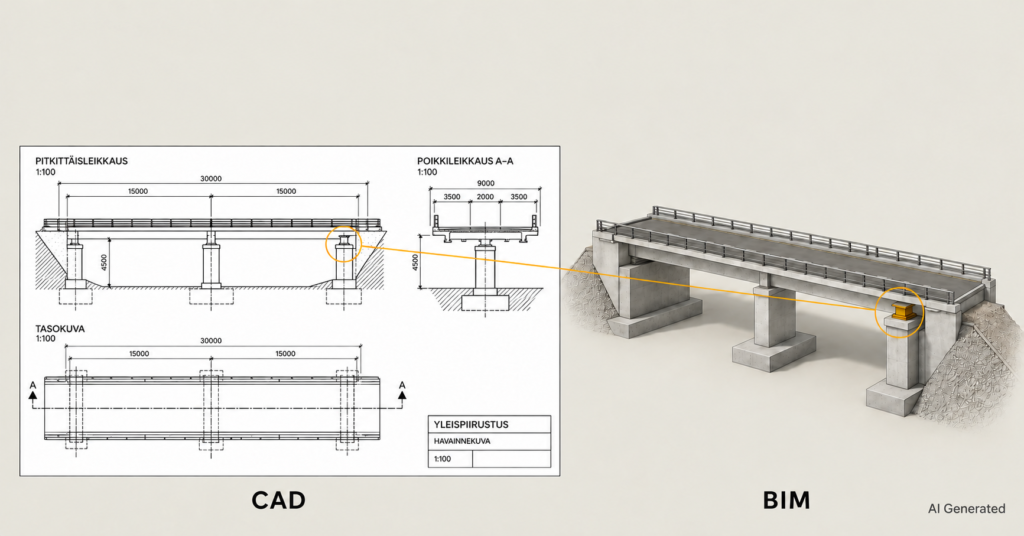
In November I presented Bridget, which we are developing for quality assurance in road and rail design, at the KIRAHub and INFRA ry startup event. In a road plan, the location of a culvert changes in the information model. Before handover, the inspector needs to see that the same change also shows in the drawing. If the difference is only found at the next work stage, someone has to go back and work out which data is up to date.
In building construction, the same thing is checked across different data. In building automation, whoever draws the wiring diagram needs the correct device ID from the control diagram. In reinforcement, a change to the bending dimension of a single bar has to get from the drawing into the rebar schedule used by the factory. In every case, the next person needs to be sure they have the right information before they continue.
Development work in building automation is already under way. The symbols and device IDs in control diagrams are being compared with the RAVA3Pro project's published building services code lists and vocabularies. The code tells what kind of device it is. The device ID tells which individual device it is. The aim of the pilot now being prepared is to find missing or conflicting markings before handover, so the designer can correct them before the next person needs the information. Building services code lists and vocabularies from the RAVA3Pro project
This is where KIRAHub's Linked Building Data Finland and buildingSMART Finland come together in the same work. Linked Building Data Finland develops shared ways to describe and connect information across systems. In buildingSMART Finland's Building Services Group the question is how agreed information gets into the model and moves forward. From the Product Industry Group's point of view, the crucial question is what information the manufacturer needs from the model. The building sector meeting has already presented both the use of the TATE code list in a hospital project and the use of model data in a production parts list. They give us benchmarks for how to organise the same check for a control diagram, a rebar schedule or a road plan. Linked Building Data Finland · buildingSMART Finland's Building Services Group · Product Industry Group · Examples from the building sector meeting
At buildingSMART Finland you can see how others use model data
Can a designer get a device's technical data from the manufacturer straight into the model? This data transfer has been discussed in buildingSMART Finland's Building Services Group. From the Product Industry Group's point of view, the other direction is just as interesting. What information does the manufacturer need from the design model to make the right product?
The building sector meeting presented both the use of the TATE code list in a hospital project and how a production parts list is created from the architectural model's data. If changes to drawings in your project are still copied to the factory list by hand, these examples give you a benchmark for your own trial. Building Services Group · Product Industry Group · Examples from the building sector meeting
Open Design Alliance offers tools for reading design files
Once we know what we want to check, the next question is whether the information we need can be got out of the files. The international Open Design Alliance (ODA) develops software tools for handling DWG drawings and IFC information models, for example. We are currently comparing how well ODA and other libraries suit Finnish design data. We are starting with drawings from different design disciplines. Can they yield the information an inspector needs to find the spot that needs a closer look? Open Design Alliance
Rakennustieto's MCP brings sources into a company's own AI tool
Through the MCP interface piloted by Rakennustieto, a company's own AI application can retrieve information from Rakennustieto's licensed content. You can ask, for example, about the quality requirements of a work stage, work methods or supervision tasks. The answer comes with source references, so you can check what the information is based on. Use requires a supported enterprise AI account, an API agreement and the necessary licences.
Back to the bathroom. The site supervisors could retrieve the inspection points for waterproofing and use them as the basis for a multilingual checklist. The same checked list could be turned into language versions for installers who need instructions in their own language. When the work area is handed over, the list shows what to check before starting. When the contractor inspects their finished work, they can record on the list what was checked and what still needs fixing.
In contract negotiations, the same search could be used to clarify the division of work. AI could compare the draft contract with the site supervision task list and raise the points the draft has not yet agreed on. Who inspects the waterproofing before it is covered? Who records the observations, and who makes sure the defects have been fixed? The parties go through the questions and write the agreed division of work into the contract. Rakennustieto's MCP introduction
Fintraffic provides open data for infrastructure trials
If you are planning temporary traffic arrangements for a road project, you can use Digitraffic's open traffic volume data to estimate when traffic is at its busiest. In the working groups of Fintraffic's transport data ecosystem, you can also find people who have already used the data and can tell you what it suits. So the data and expertise you need for a first trial may already exist. Fintraffic's transport data ecosystem · Digitraffic's open road traffic data
Join us in solving construction's shared problems
If you spend time searching for, translating or re-entering the same information, someone else may be working on exactly the same problem. That is why it is worth bringing an unfinished question to the network too. When a designer, a site supervisor and a software developer look at the same work stage, together they can spot what information is missing, what is worth trying and what would be useful to share with others.
Do you have a work stage you would like to develop together? Book a time in my calendar and bring one example to the conversation. Let's see who should be involved and what we could try first. Book a conversation
Filed under