Imagine a design office where artificial intelligence is being tested as a support for document review. A few files are selected for the experiment, useful insights are obtained from them, and the results are discussed together. Next, the solution is intended to be implemented in projects. At this stage, someone asks where the system knows which files are the most recent and to whom the observations made in them are sent.
The question directly leads to the architecture of the artificial intelligence project. In a single experiment, a human can handle many things in the background: select the data, transfer the files, interpret the response, and tell the result to the right person. When the solution is intended to be used continuously, these steps and responsibilities must be made visible. Otherwise, part of the work will still depend on people’s memory and manual dexterity.
In previous topics of the series, we have discussed data quality, choosing the first development point, costs, and measuring change. Now these issues are brought together in the same picture. The architecture of an artificial intelligence project helps to understand how data, tools, and people's work form a functioning whole.
Architecture makes dependencies visible
Architecture may sound like a subject that belongs on the desk of technical experts. From the management perspective, however, it has a very practical role: to describe how the desired operating model can be implemented and what its functioning depends on. What information is needed? How does information move? Where does a decision-maker make a decision?
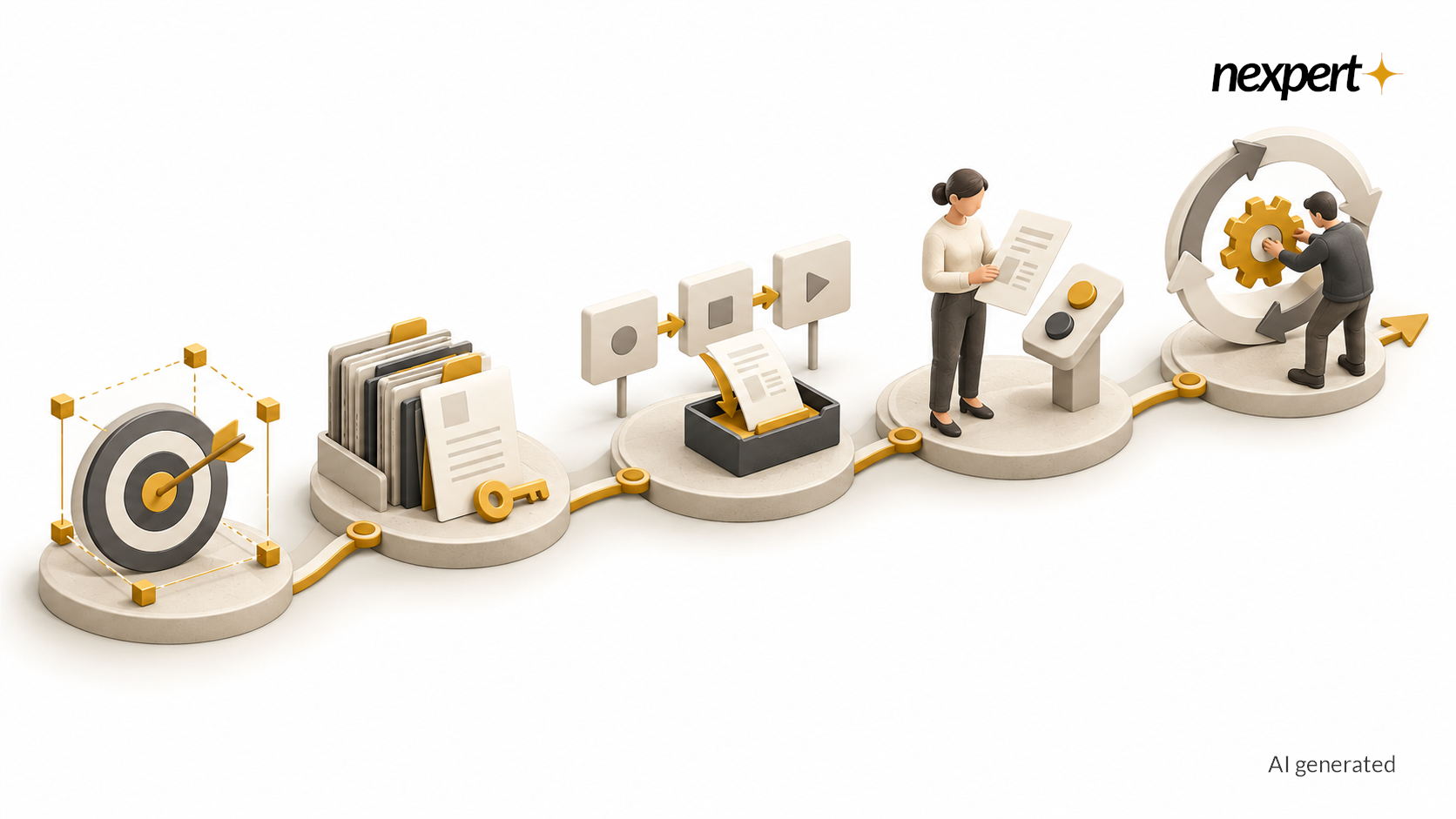
In a solution supporting the review of the design data, the overall process could progress from selecting the data to its processing, evaluating observations, and recording the follow-up actions. Different tools may be needed at different stages. The role of artificial intelligence must be limited as part of this workflow, and approval of the result must be shown to the person responsible. An example illustrates how the work is organized, not the inspection guide for technical design.
A common description helps identify missing parts as well. If the material is in the project bank but observations remain in a separate discussion, someone has to move them to be processed. If this task is not taken into account, a new solution may bring one more tool without improving the overall workflow. Making dependencies visible helps assess implementation even before the procurement process begins.
Business Technology Standard provides a common framework
Business Technology Standard, or BTS, is an open management framework for planning, developing, and continuous operations of business technology. It includes, among other things, needs management, strategy and control, development, and service operations. Roles and responsibilities as well as data and artificial intelligence management are also included. You can learn more about the framework here. Business Technology Standard's own website.
Alongside architecture, BTS helps to examine how development is managed throughout its entire lifecycle. In architecture, the components of a solution and their connections are described. In a management model, decisions are made regarding, for example, decision-making, responsibilities, monitoring of benefits, and organizing continuous operations. These are needed together to bring the plan into practice.
In practice, the person responsible for the business defines the intended benefits, users describe the needs of the work, and technical experts assess the prerequisites for implementation. In project management, these perspectives are brought together and open decisions are made to be resolved. At the same time, it is agreed who owns the solution after its implementation.
In a small organization, the same person can hold several roles. Even then, it’s worth recording what decisions they are responsible for and where the expertise of others is needed. This way, responsibilities don’t become assumptions. The following questions are my own practical approach to leading an AI project, not an official checklist for the BTS.
Five decisions before committing to implementation
1. What work step is being changed?
The goal should be described in such a way that its impact on the work can be identified. ”Utilizing artificial intelligence in quality assurance” leaves much open to interpretation. A more specific goal could be that the inspector receives a preliminary list of observations from the adjusted material for their own evaluation. Then it can be discussed what the list should contain and on what basis the experiment should be evaluated.
When setting the boundary, the authority of artificial intelligence is agreed upon. Does it generate suggestions, record observations, or can it also initiate further actions? These options have different effects on workflow and control. Management must understand what kind of approach the organization is committing to.
2. Where does the information come from and with what rights is it used?
In the topic of data quality, the focus was on the usefulness of the information and on common definitions. In architecture, the question is also how to get the right information to the right place. Who is responsible for the data, how to identify the used version and what access rights the solution has? These issues must be clarified with the owners of the data and technical experts.
For example, access to the project folder does not yet indicate whether all the content in it can be processed in the selected service. The terms of use for the material, contracts, and the organization’s own requirements must be clarified before a decision is made regarding implementation. It is the management’s responsibility to ensure that the study has a responsible person and that its results influence the choice of solution. An open question is recorded for decision-making so that the implementation is not based on an assumption.
3. How does the result end up being part of the work?
The observation produced by the solution requires a receiver and an agreed method of handling it. If an employee has to search for the results of a new service, copy them into their task list and report on them separately, these steps are part of the evaluation of the implementation. The work can be accepted in a limited trial when the number of it is known. In a broader use, a decision is needed on how the work will be organized.
Here, it is worth going through a real work situation from start to finish with the user. From where they start, what they do after receiving the observation and where the final result of the process is recorded? At the same time, it becomes clear what existing work steps can be eliminated. If the old and new approach remain in parallel permanently, the sought-after time savings can lead to double the amount of documentation.
4. Who is responsible for the results and exceptions?
In addition to the normal workflow, a method is needed for situations where processing is left unfinished or the result is unclear. Missing data, broken communication, or an interpretative observation must be communicated to someone. The user must also be able to distinguish between successful processing and unsuccessful ones. Otherwise, the lack of results can be misinterpreted.
Management and experts need to agree on who will check the results, when work will be stopped, and how to continue if necessary without a solution. These decisions affect both implementation and onboarding. The responsibility for inspection given to a person requires time, expertise, and sufficient knowledge to make the assessment. A mere approval button does not solve this.
5. Who owns the solution after the project?
The end of the project is one point where responsibility can become unclear. The developer has completed the agreed implementation, but someone has to take care of user support, changes, and cost monitoring. The initial data, systems, and organizational practices can also change. The solution requires an owner who has the ability to respond to these changes.
Before implementation, it is also worth agreeing on the tasks of the suppliers and the basis on which further development is ordered. It is a good idea for the organization to know how to make its own materials and work results available if the service is later replaced. This way, future alternatives can be evaluated already at the procurement stage. Ownership also includes the decision on when the use of the solution is no longer worthwhile to continue.
The same choices are reflected in costs and metrics
Architecture links previous budgeting and measurement topics to decision-making regarding implementation. Integrating systems, implementing access rights, training users, and maintaining them require resources. If any of these are left outside the cost estimate, the budget only represents a part of the whole picture. Similarly, the information transfer left to manual handling is reflected in the users’ time spent.
In the metrics, it is worth monitoring the entire selected workflow. In the hypothetical example, creating the observation list can be reduced from half an hour to five minutes, but preparing the data and transferring the results can take another twenty minutes. In that case, the process’s time savings is five minutes. The usefulness and time required for reviewing the results must also be taken into account in the evaluation.
Therefore, the measurement method should be planned while the workflow is being described. How do we know when the processing started and when the observation was resolved? Who collects the data and evaluates the results? When these matters are agreed upon in advance, it is easier to decide on the next steps based on the actual benefits after implementation.
Start with a one-page description
Before requesting a broader implementation decision, I would like a one-page description of the whole project. This should include the goal, users, data sources, systems to be used, the role of artificial intelligence, and human decision-making points. The owner and essential open questions should also be included. The goal is to create a common discussion framework for decision-making.
The description is discussed with the user, the business owner, and the technical implementer. Everyone should be able to identify their own part of the process and tell what is still missing. One step is the starting point: the more detailed descriptions and clarifications required for the implementation are made based on this. This way, the details are tied together with the jointly understood goal.
Management needs to understand how the solution works as part of the work and what it requires to function properly. In practice, this means decisions that are sufficiently clear regarding limitations, knowledge, responsibilities, and ongoing activities. When these are visible, the technical implementation can be evaluated in relation to the desired benefit.
The following article examines the whole issue through the design material: what does the comparison between drawing and data model actually entail? Then the same questions about the flow of information, the functions of tools, and the responsibility of the human being arise in a concrete situation.
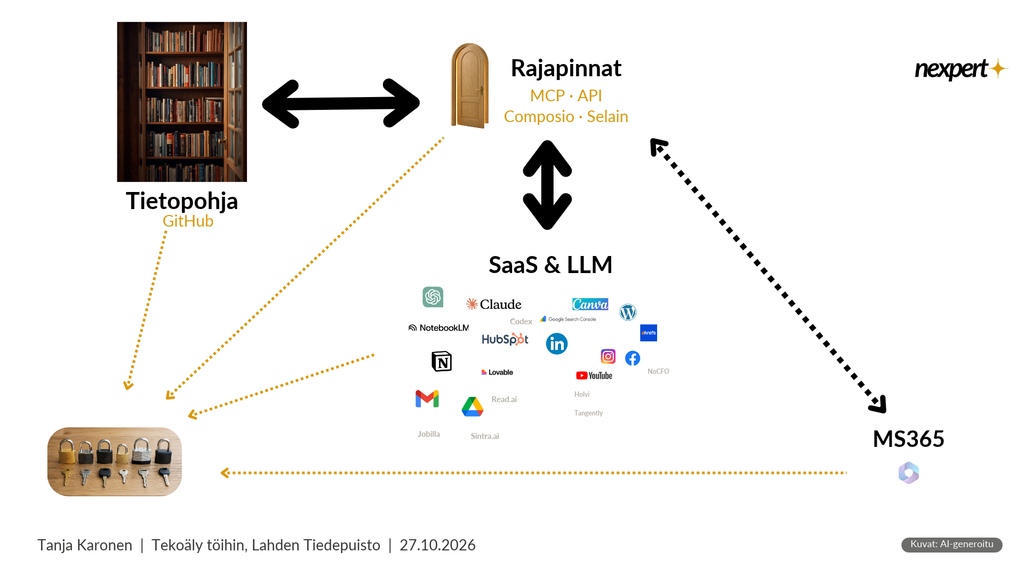
Below is a simplified example of how Nexpert has implemented architecture.
Filed under