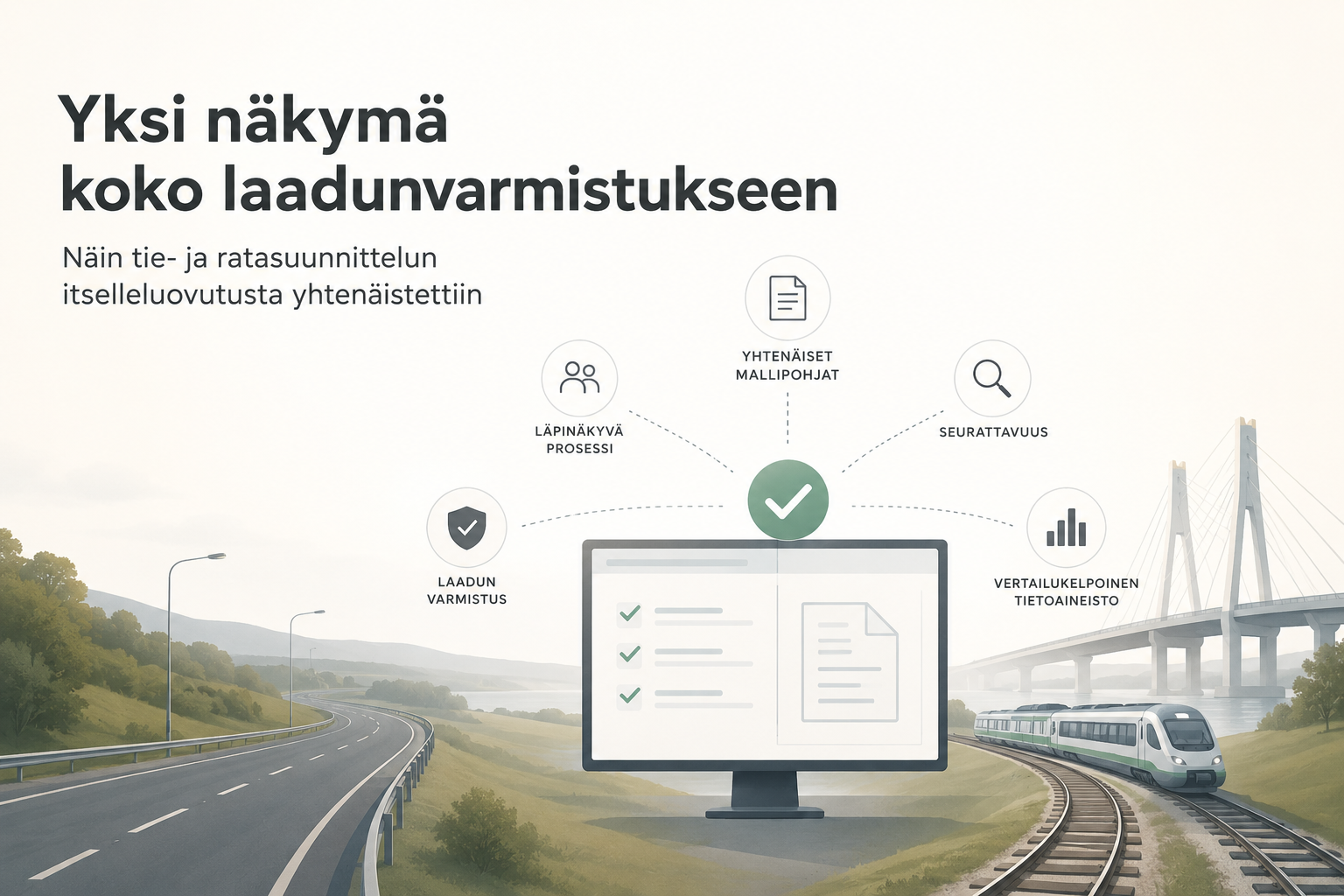
How the self-assessment process in road and railway planning was standardized
Tanja Karonen
Road and railway planning is a long, multi-stage, and closely regulated process. Planning is governed by EU regulations, national legislation, the technical and safety guidelines of the Finnish Transport Infrastructure Agency, as well as RTJJ, the Railway Operators’ Safety Management System, and TPJJ, the Road Maintenance Safety Management System.
A planning project can last several years, and in the largest projects, the entire lifecycle from planning to implementation may extend to as long as twenty years. During this time, people, organizations, and systems change. Regulations, legislation, and the technical and safety guidelines that specify them may also evolve. They are continuously updated as research, practical experience, and our understanding of environmental impacts develop.
Recent years have provided concrete examples of these changes. Requirements concerning the handling of excavated soil have been further specified, including when soil can be reused in construction and when it is classified as waste. Finland’s new Building Act, which entered into force in 2025, introduced a new procedure for the temporary storage of uncontaminated soil, while regulation concerning the investigation, classification, reuse, and handling of excavated materials continues to evolve.
The consideration of nature and environmental impacts has also expanded. Finland’s new Nature Conservation Act entered into force in 2023, while the EU Nature Restoration Regulation, adopted in 2024, reinforces the direction toward more systematic consideration of biodiversity and ecosystem health. Infrastructure planning increasingly emphasizes areas such as climate change adaptation, low-carbon solutions, material efficiency, and impacts on water and soil.
In the future, new information may lead to very concrete needs for changes. For example, more detailed information about flood risks and weather conditions may affect drainage or structural solutions. New information about contaminants may change how excavated soil is handled, while new findings about environmental conditions may require additional nature and environmental assessments. As a result, a plan developed at an earlier stage and fully compliant with the requirements at that time may need to be updated years later before detailed construction planning or implementation begins.
Information management throughout the lifecycle of planning projects has required further development, and Nexpert has been involved in this work. Self-assessment templates for quality assurance in road and railway planning were developed between 2024 and 2026. The objective has been to standardize quality assurance practices across engineering and design consultancies and make the self-assessment process transparent, traceable, and verifiable afterwards.
The templates for general, road, and railway plans have now been published and are in use. Development of the template for detailed construction planning will continue throughout 2026, with publication currently expected in 2027.
Why Was a Standardized Self-Assessment Model Needed?
In this context, self-assessment refers to the quality assurance performed by the service provider on its own planning documentation before the material is submitted for further review or delivered to the client.
The client has required engineering and design consultancies to carry out self-assessments in the past as well. However, the practices and level of documentation have varied from project to project.
In some projects, the different stages of quality assurance have been documented in considerable detail. In others, the document verifying the self-assessment may have been a brief summary confirming that the review was completed and identifying the people involved.
However, a brief summary does not always provide sufficient detail about:
- what materials were reviewed
- how thoroughly the review was conducted
- who reviewed the materials
- when the review was carried out
- what observations or issues were identified during the review
- whether the identified issues were corrected.
The aim is not to evaluate the performance of individual design firms, but to establish a common minimum standard for all projects. When the quality assurance stages are documented using the same structure, the client receives a comparable overview of the project status, and the service provider’s own work is also easier to trace.
A common minimum requirement does not mean that every project or design firm must do everything in exactly the same way. The scope of projects, the materials involved, and the need for reviews vary. The purpose of the template is to provide a shared framework within which project-specific information and checks can be described with sufficient detail.
This also makes it easier for the client to compare different projects. When the information follows the same structure, understanding the project status does not depend on how each service provider is accustomed to naming documents or reporting the progress of reviews.
Simply confirming that quality assurance has been carried out does not make its content visible. A common template shows what was reviewed, who carried out the review, and how the findings were handled.
In a long design process, information can be lost surprisingly easily
Infrastructure project design progresses in stages. The process may include a preliminary study, general planning, road or railway planning, and construction planning. This is followed by construction and, ultimately, the operation and maintenance of the infrastructure. Not every stage is required in every project, but in large projects the process can be long.
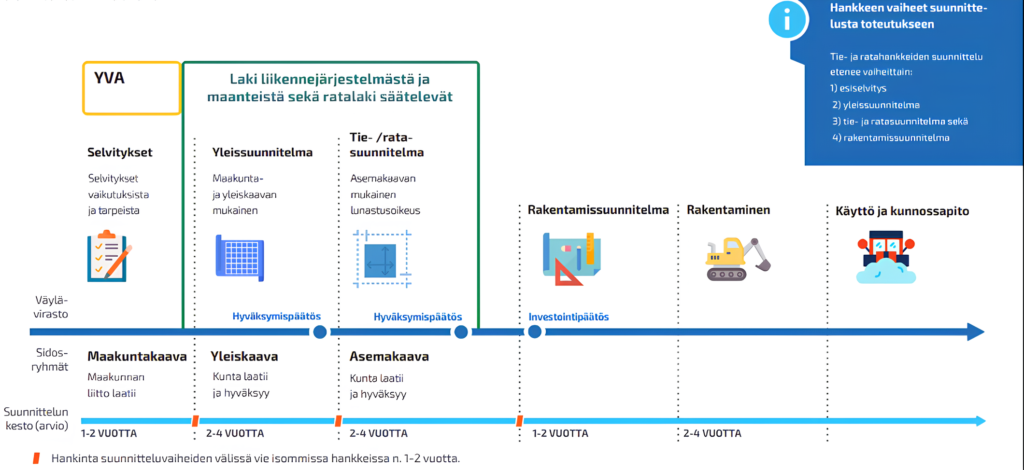
A large amount of material is produced at different stages of the design process, including plans, reports, drawings, calculations, and other documents. At the same time, the level of detail increases from one stage to the next.
A plan created at an earlier stage may have fully met the requirements at the time. However, when the project moves into construction design several years later, the original source information may no longer be sufficient.
For example:
- requirements or guidelines may have changed
- the system being used may have changed
- the surrounding land use may have changed
- the required level of design detail may have increased
- the source data may need to be supplemented
- some areas may still lack sufficient ground investigations
If such a gap is identified during one design stage but is not clearly documented, the information may be lost before the next stage begins.
The risk is particularly high because the people involved in different design stages may not remain the same. Design services are procured through public procurement, and the service provider or the individuals working on the project typically change between design stages.
For this reason, information cannot be left to the memory of an individual project manager, designer, or reviewer. It needs to be documented and transferred to the next stage of the project.
The template brings the overall status of the design into one place
The self-handover template is not an actual plan or document repository. Not all drawings, models, and design documents are stored inside the Excel file.
Instead, the template acts as a table of contents for the design material, a status overview, and a tool for traceability.
It shows:
- what material has been produced in the project
- what stage each item is currently at
- where the actual material can be found
- who prepared the material
- who reviewed it
- when it was prepared or reviewed
- what correction needs have been identified
- whether the corrections have been addressed
- what needs to be taken into account in the next design stage
When the project material is revisited years later, the investigation does not need to start from scratch. The template shows who prepared the material, when it was prepared, and where the actual plan can be found. It also shows how the material has progressed through the quality assurance process.
This is especially important when the original designers or project managers are no longer involved in the project.
Four perspectives on the same review process
In the template, the fields for different users are separated by colour. Light blue fields are for the designer. Yellow fields are for internal review. Different shades of green are used for the external reviewer and the client’s review fields.
The designer enters the table of contents for the design material and its current status into the Excel file when the material is sent for internal review. The basic structure of the material list comes from the guidance, but the designer must adapt it to reflect the actual content of the project.
The internal reviewer checks the material and records either the required corrections or confirmation that the material has passed the internal review.
Depending on the project and the material, an external reviewer may also be involved. They record comments, correction needs, and approval in the same way.
The template also records the dates when the material was sent by the service provider for external review and when it was returned. These dates are also relevant for monitoring the contract and schedule. Deadlines are usually agreed for both the review itself and for correcting identified deficiencies.
After the external review, the material is transferred to the client or design management representative. The client assesses whether the material is ready to be accepted.
The different parties involved in the process can also record observations that need to be taken into account in later design stages. For example, if the designer knows that sufficient ground investigation data is not yet available for a certain area, this can already be recorded at that stage. The same kind of observation can also be made by an internal reviewer, external reviewer, or the client.
The most important thing is that the observation does not remain only in an email or in one person’s memory.
However, the template does not carry out quality assurance on behalf of the user, nor does it replace professional judgement. It makes the review chain visible and guides users to document decisions and deficiencies in a place where they can also be found during the next design stage.
The same process for road and railway design
The material produced in road and railway design is not exactly the same. The material lists are based on different guidelines, and the designer must always adapt the list to suit the content of the specific project.
However, the quality assurance process itself has been kept as similar as possible. In both cases, the basic sequence is the same: designer, internal review, possible external review, and client acceptance.
A consistent process makes the system easier to use, particularly in organisations that work on both road and railway projects. Users do not need to learn a completely different quality assurance model for each type of project.
A common structure also makes future automation easier. A technical solution does not need to be rebuilt from scratch for every design discipline if the basic logic of quality assurance can remain the same.
First a functioning process, then the software
The development work began in 2024 with workshops involving project management and design management experts from the Finnish Transport Infrastructure Agency and the former ELY Centres.
In the first workshops, one of the questions was whether the quality assurance process should be implemented directly as an automated software solution.
However, we concluded that it does not make sense to code an unclear or untested process into software first. A model should first be created and tested in real projects.
Excel was selected as the first development platform because it allowed the process to be built, modified, and tested relatively quickly and cost-effectively.
During 2024, expert workshops were organised for both road and railway design. The first Excel versions were developed based on these workshops.
In 2025, the templates reached a stage where they could be released for piloting. User feedback was collected during the pilot, and the content and usability were improved based on that feedback.
In 2026, development has continued together with construction design project managers and experts. Construction design materials and requirements differ partly from earlier design stages, so it has not been practical to copy the existing template directly without modification.
The development work has progressed step by step, as finding common time for a large group of experts has sometimes been challenging. At the same time, this broad participation is one of the strengths of the model: the template has not been built around the assumptions of one individual, but has been developed and iterated together with project managers and design management experts.
Nexpert’s role has included facilitating the workshops, structuring the process, building and further developing the Excel templates, and preparing training materials. Nexpert is also involved in planning the future technical solution.
The pilot revealed the limitations of Excel
The pilot showed that Excel works well for defining and testing the process, but it does not solve all challenges related to shared use. Organisations do not necessarily have a common Teams or SharePoint environment where the same file can be edited simultaneously.
If the file needs to be downloaded, edited locally, and uploaded back to the platform, the result may be:
- multiple parallel versions
- overlapping revisions
- uncertainty about which file is the latest
- duplication of information
- names and dates entered manually
- review requests and responses sent by email
Automation can be added to Excel, but it cannot reasonably eliminate all of the challenges associated with shared use across multiple organisations.
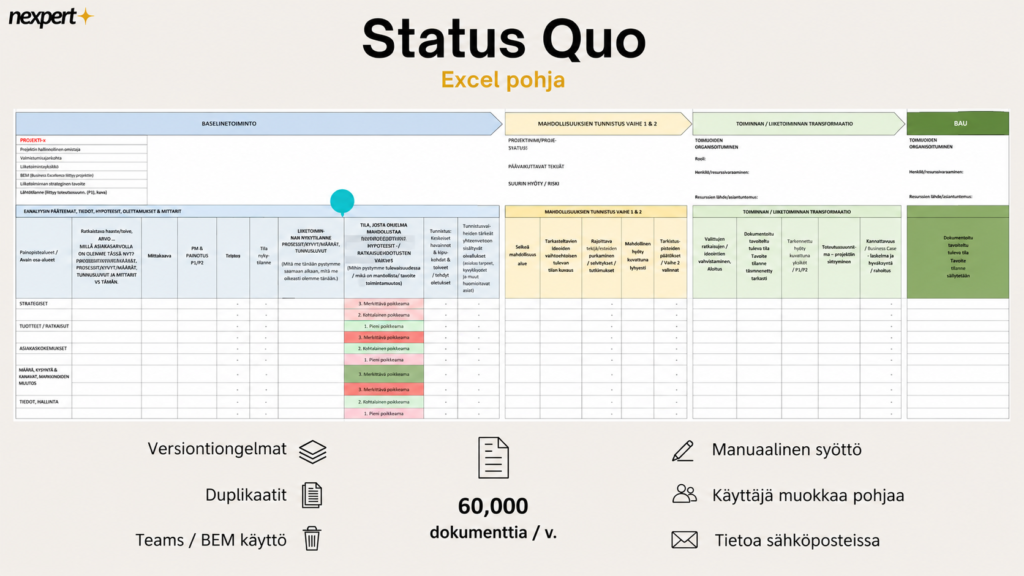
For this reason, Excel should not be seen as the final product. It is the first development stage, which has made the actual process visible and possible to test.
This stage has been necessary so that the technical solution can later be developed in an agile and cost-effective way based on real needs.
At the same time, the pilot has revealed what information users actually need and which parts of the process create the most manual work. Without this stage, the software might have included features that look impressive in a demonstration but do not solve the everyday problems faced by designers, reviewers, or project managers.
Once the functioning process has first been described in Excel, the requirements for the technical solution can be defined much more precisely. This reduces development risk and makes it easier to introduce the solution step by step.
What are the benefits of the model for designers?
From a designer’s perspective, the template should above all simplify complex work.
When the status of the material is visible in one place, the designer does not need to repeatedly answer the same project management questions: Where is this plan? Has it already been reviewed? Who reviewed it? Which version is the latest? Have the external reviewer’s comments already been addressed?
The template reduces the need to send files and information back and forth by email. The version history is also easier to follow.
A well-completed template also helps protect the designer. It provides a clear record of what material was produced, when it was submitted for review, and how the comments were addressed.
This is therefore not just an administrative document prepared for the client. It is also a tool for managing and verifying the designer’s own work.
Quality assurance reviewers need a quick way to get back into a project
An internal or external reviewer may be responsible for dozens of projects.
When a reviewer returns to the material of a particular project, the first task is often to reorient themselves: What was this project about? What have I already reviewed? Where did we leave off last time? Which comments are still open?
If the information is scattered across folders, emails, Teams conversations, and different Excel versions, returning to a project can take a surprising amount of time.
The self-check template provides a single view from which the quality assurance reviewer can quickly refresh their understanding of the project status.
This may sound like a small issue. However, when the same situation is repeated across dozens of projects, the impact on workload becomes significant.
For the client, the most important things are the overall picture and traceability
A client’s project manager or design manager may be responsible for several projects at the same time.
Using the template, they can see at a glance:
- what stage the materials are at
- how the reviews are progressing
- what the project schedule looks like
- who carried out the quality assurance
- when the reviews were completed
- what corrections are still outstanding
A project manager cannot personally go through every review stage of every design document. Even so, they still need to be able to verify that the agreed quality assurance has been carried out.
The timestamps, personnel information, and review history recorded in the template make this visible.
Traceability is also important if a quality problem is later identified in a design. In that situation, it must be possible to determine at what stage the problem arose, whether it had been identified earlier, how it was handled, whether the correction belongs to the original assignment, whether the service provider must correct the error without additional compensation, or whether it is new work that needs to be commissioned separately.
Without a documented review history, resolving these issues may require a lengthy process of going through emails and contracts.
The next stage will reduce unnecessary manual work
The first technical development stage does not need to be a complex AI system. Instead, the focus should be on simple tasks that software can perform more reliably than a person.
When a user uploads material or makes an entry, the system can automatically record:
- the name of the material in the table of contents
- who made the change
- what was changed
- when the change was made
- which revision was created
- the current status of the material
At the same time, different organisations should be able to use the system without having to download and upload Excel files back and forth between platforms. Automatic revision history and shared access alone would eliminate a large proportion of the current problems.
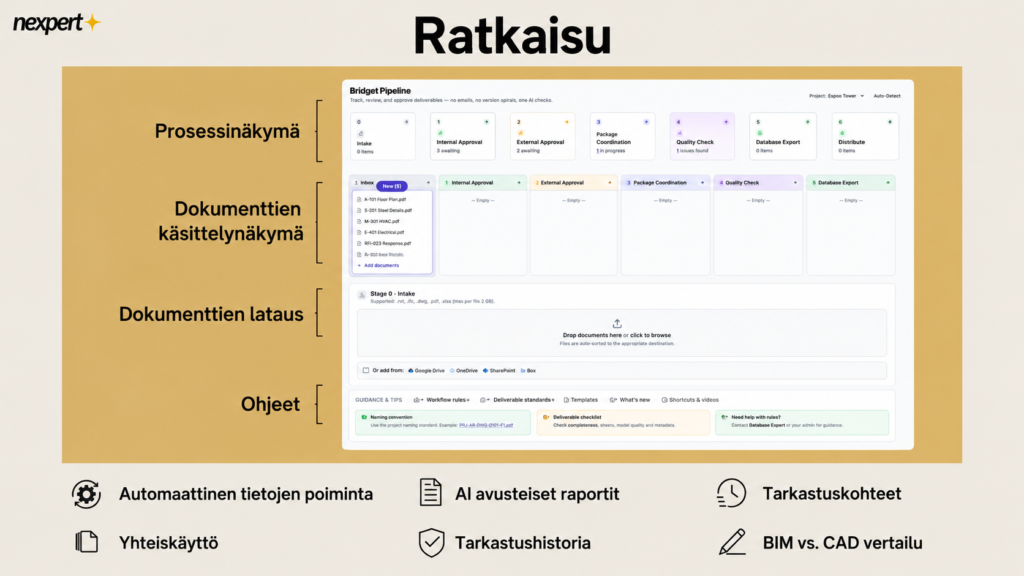
In the next stage, the system could include process views, automated review reminders, dashboards, and reporting features. A project manager could monitor the status of several projects from a single view and identify, for example, overdue reviews or outstanding corrections.
The greatest future potential lies in comparing CAD and BIM data
Simply moving the Excel template into an online service would not yet deliver the greatest possible time savings. A more significant opportunity lies in automating the quality assurance of the actual design material. AI solutions can be developed for clearly defined tasks, and one of the most promising use cases is the comparison of CAD drawings and BIM models.
The system could check whether different data formats are consistent with each other and highlight the areas where discrepancies occur. The aim is not to remove the expert’s responsibility, but to focus their time on the points where professional judgement is genuinely needed.
A very cautious estimate has been made of the potential savings. In transport infrastructure design, approximately 60,000 documents go through quality assurance each year. This figure is not an official statistic confirmed by the Finnish Transport Infrastructure Agency, but an indicative estimate.
If a digital solution saved, conservatively estimated, 5–10 minutes per document, the annual saving would amount to approximately 5,000–10,000 working hours. Using 1,600 hours as the calculated annual workload of one full-time employee, this corresponds to roughly 3–6 person-years.
At this stage, the estimate covers only the Finnish Transport Infrastructure Agency’s own working time. Any time savings achieved by designers and reviewers at consulting firms would come on top of this. The overall potential is therefore considerably greater than the development of a single Excel file might initially suggest.
The same process can be adapted to a consulting company’s own needs
The template developed for the Finnish Transport Infrastructure Agency is based on the client’s quality assurance requirements. However, the same process-based approach can also be adapted to the internal operations of consulting companies.
A company may have its own review stages, approval limits, responsibilities, project types, or systems. In one organisation, a process involving only the designer and an internal reviewer may be sufficient. In another, the process may also include a separate quality assurance specialist, external review, and several client approval stages.
Ultimately, the defining factor is not Excel or any specific software. It is the process: how does a design move from the designer to internal review, possible external review, and finally to the client? Once this process has been described, the template and its automations can be adapted to the company’s needs.The same approach is not limited to transport infrastructure design. It can also be applied to building construction and technical design more broadly, wherever material passes through several design and review stages.
The solution also has international potential
Long design chains, fragmented documentation, and the traceability of quality assurance are not problems unique to Finland.
Railway systems in particular are extensively governed at EU level. Practices, contract models, and national legislation are not identical between countries. However, the fundamental quality assurance challenge is widely recognisable: how can we ensure that information created during a long design process is preserved, that reviews can be verified, and that all parties have access to the same project status?
If the technical solution is built to be configurable, it can later be adapted to the processes of other countries and organisations as well.
The templates are now in use
The self-check templates for general, road, and railway plans have been published, and their use is a requirement in the relevant Finnish Transport Infrastructure Agency design projects.
The construction design template is still under development. The work will continue during 2026, with publication currently estimated for 2027.
Published templates and related materials can be found on the Finnish Transport Infrastructure Agency's consultant extranet: The published templates and related materials are available on the Finnish Transport Infrastructure Agency’s consultants’ extranet: Self-check templates on the consultants’ extranet..
Do you need training or your own version of the template?
Nexpert provides training on how to use the Finnish Transport Infrastructure Agency’s self-check templates.
The training is suitable for designers, internal reviewers, quality assurance specialists, project managers, and design managers.
A custom version of the quality assurance template can also be built for the consulting firm. In this case, the process, material lists, responsibilities, inspection phases, and any Excel automations are customized according to the company's actual needs.
A consulting company can also have its own version of the quality assurance template developed. In this case, the process, material lists, responsibilities, review stages, and possible Excel automations are adapted to the company’s actual needs.
Training can also be tailored to different roles. Designers need to understand what they must record before internal review. Reviewers need to know how correction needs and approvals should be documented. For project management, the most important aspect is learning how to use the model to monitor project status, schedules, and traceability.
The goal is not to introduce yet another form that needs to be filled in. The goal is to make complex design quality assurance easier to manage, trace, and automate.
| Contact Nexpert if you need training on how to use the template or if you want to develop a quality assurance process tailored to your organisation. |
Filed under