
What should You plan in advance?
A Master's thesis at a university of applied sciences can be a surprisingly effective way to implement a public sector RDI project. The organization gains access to research-based development, fresh expertise, and an opportunity to examine its own operations a bit more deeply than standard project work. For the student, in turn, it provides an opportunity to complete a thesis that has a real commissioner, a genuine development need, and, in the best-case scenario, also a concrete end result to be implemented.
I did my Master's thesis in the Business Technologies degree program at Haaga-Helia as part of a public sector RDI project in 2025. The topic of the thesis was the utilization of Lean methods and artificial intelligence in the management of multichannel feedback. Over the course of the year, the work ultimately included 23 iteration cycles, several different data collection methods, workshops, surveys, interviews, and steering group work. The experience was extremely good. But if I were to start a similar project now, there is one thing I would do more thoroughly even before the project officially got underway:
I would build the research plan from the start to meet both the institution's and the commissioning organisation's needs.
Two organizations, two templates, and easily two plans
In the Master's thesis (YAMK), the research plan is not made solely for the commissioner. The institution has its own academic requirements. At Haaga-Helia, the research-based development work was preceded by a course during which a preliminary research plan was drafted. The plan was prepared according to the institution's own format and submitted for the supervising lecturer's approval.
When I took the plan to the commissioning organisation as the RDI project plan, I ran into a different template. The content had many of the same elements, but the structure couldn't simply be carried over as-is. In practice, the same things had to be partly rewritten in a different format.
Not a disaster, but unnecessary duplication of effort.
That's why my first practical recommendation is very simple:
Before writing the research plan, put both the institution's and the commissioning organisation's requirements on the table.
See whether it's possible to create one plan that meets both needs. At the same time, it's worth agreeing on what kinds of reports will be needed at the end of the project.
I ended up producing two final reports. An academic report for the institution, and a more practical version for the client — stripped of research jargon and focused concretely on how the findings could be applied in the organisation. That turned out not to be a bad thing in the end, either. The second round of reporting forced me to refine the results once more. But it's worth making that a conscious choice rather than only realising it at the end of the project.
Crop – And then crop once more
Right from the start, the topic of my thesis sounded broad: Lean methods and artificial intelligence as methods for multichannel feedback management. And so it was. In the theoretical framework, I discussed Lean thinking, especially continuous improvement, as well as artificial intelligence. However, the practical research phase involved a lot more.
We found out, among other things:
- all the channels through which feedback, requests for action, and correction demands come into the organisation
- how feedback processing could be automated
- what supervisors should do
- what specialists should do
- how to move forward in collaboration with the AI Centre of Excellence
- what kind of feedback management approach the organisation needed
- how automation should be rolled out step by step.
The client's goal was a process description for feedback management. I myself also wanted to build a roadmap for a learning organization that would show what needs to happen in the different phases, especially from the perspective of utilizing automation and artificial intelligence.
Looking back, almost any one of these areas could have been a sufficient YAMK thesis on its own. The broad scope wasn't wasted. Quite the opposite — it developed my professional expertise far more than a narrower study would have. But in terms of workload, it came at a price.
If a YAMK thesis is being used to carry out an RDI project, it's worth distinguishing between two questions:
What does the organisation want to find out?
and
What part of that is it reasonable to explore within a single thesis?
They are not necessarily the same thing.
The research plan must also be able to adapt to a changing world
In an RDI project built around new technology, there is one particular problem: everything cannot be known in advance. This is currently emphasized especially in artificial intelligence.
In its Work Trend Index 2025 report, Microsoft describes the evolution of AI in organizations through three stages. First, people use AI as a personal assistant. In the next stage, people and AI agents form teams together. In the third stage, humans lead, and agents carry out an increasingly larger portion of processes under human supervision. Microsoft refers to such more advanced organizations as Frontier Firms -organisaatioiksi. (Microsoft)
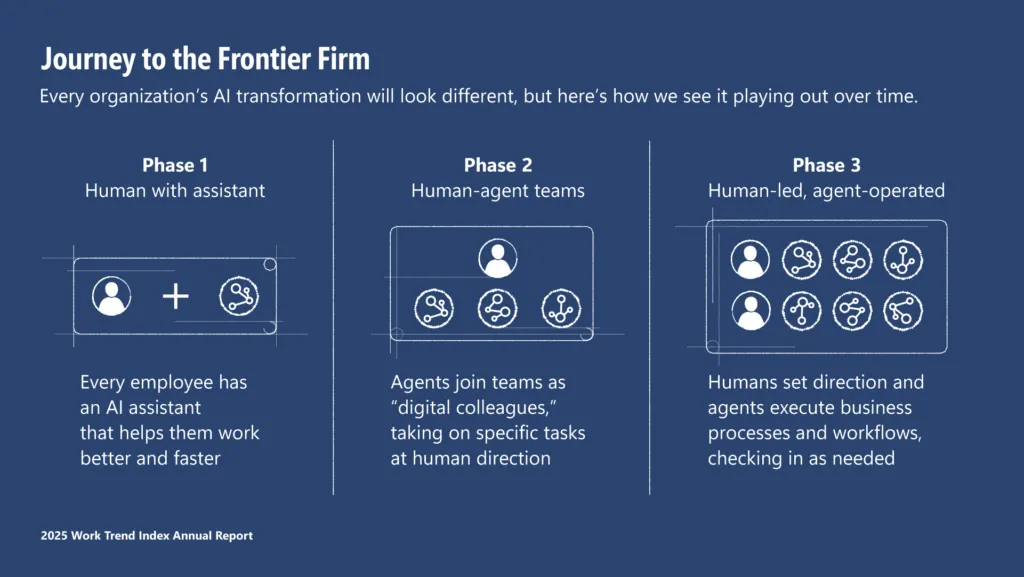
Image: Microsoft, 2025 Work Trend Index Annual Report. An organization's AI development is progressing from personal assistants to teams composed of people and agents, and further to processes led by humans and operated by agents.
This illustration also clearly highlights the challenge of an RDI project. For example, if we study the use of artificial intelligence in an organization for a year, the subject of the study may no longer be the same at the end of the year as it was when the study began. That’s why I wouldn’t want to pin down the final technical solution too precisely in the research plan.
I chose service design as the approach for my own work precisely for this reason. It enabled iterative progress. After each round of data collection, the results were analysed and the next phase was decided based on them.
Even the research questions changed during the work.
From the institution's perspective, this worked well, because the chosen approach allowed for changes.
This is something worth taking the time to consider when drafting your research plan. The choice of methodology is not just a mandatory research component of a thesis report. In practice, it determines how much flexibility the project has.
The schedule is often determined by data collection, not reporting
A thesis can be given as tight a schedule as you like on paper. In practice, the pace of a public sector RDI project is often determined by something else entirely: when the people you need can all be gathered in the same place at the same time.
My project involved key figures, experts, working groups, stakeholders with expertise in artificial intelligence, and the client’s steering committee. Organizing a single interview is usually fairly easy. A facilitated workshop, on the other hand, which requires several experts, is a different story. Everyone’s calendars are full.
In public administration, resources have been tightened in recent years. New personnel are not necessarily hired to replace those who retire, and at the same time, experts' calendars are filling up with meetings and Teams sessions. Hybrid work has also changed the exchange of information. Previously, some discussions happened naturally in hallways or at the coffee table. Now, a venue sometimes has to be explicitly created for this kind of information exchange as well. Therefore, six months can be plenty of time for an RDI thesis if the objective is precisely defined, the participants are known in advance, and data collection can be clearly planned—in a large project, a year can be entirely realistic.
Analysis and reporting are much more easily fitted into the researcher's own calendar. The greatest scheduling risk comes from data collection.
The steering group is not a formality
In my own project, the client's steering group met about once a month. I didn't just take a status update there. I analyzed the results of the previous data collection round, made a proposal for the next phase based on them, and took it to the steering group for a decision.
The steering group was able to approve the proposal, modify it, or reject it. This proved to be a highly functional model.
In an iterative project, the student should not be left alone to guess which direction the client wants to go next. On the other hand, the client does not need to participate in all daily activities either. Regular decision points solve this.
I would recommend agreeing on regular meetings for the entire duration of the project right at the beginning. It's a good idea to send calendar invitations immediately rather than trying to find a new common time every month. In addition, the organization needs to have a person who can answer questions, make decisions, or at least guide the student to the right person.
Select the student based on substance as well
The strength of Master of Business Administration and Engineering (UAS) students in RDI projects is that they usually already have several years of work experience. Still, the student's background plays a significant role. If the researcher is already familiar with the industry and understands the organization's operating environment, time can be spent on actual development. If they start completely from scratch, the organization's experts' time is easily spent teaching the basics of the field.
In my project, a strong understanding of infrastructure, engineering, and construction helped significantly. I was able to have direct conversations with specialists about their own operating environment, rather than spending the first months simply gaining that understanding.
That's why a student shouldn't be chosen solely on the basis of who needs a thesis topic. It's worth also asking:
What should they already know, so they can challenge us rather than simply learn about what we do?
What should I do before starting the next project?
I wouldn't go back and change my own project very much. Precisely because of its scope and many iterations, it was very educational. But two things I would do right from the start next time.
First, I would combine the requirements of the educational institution and the client's research plan as closely as possible into a single plan.
Secondly, I would agree right at the beginning on what kind of final output will serve both the research reporting and the practical needs of the organization.
Additionally, right at the beginning of the project, I would do three things: narrow down the research problem precisely, agree on the client contacts and regular steering group meetings, and spend an exceptional amount of time on realistic scheduling of data collection.
A Master's thesis at a University of Applied Sciences can be a very good way for public administration to implement an RDI project. However, it should not be treated merely as a thesis. At best, it is a real development project that combines research-based knowledge, the organization's substantive expertise, and practical experiments. And that is precisely where the greatest benefit of this model lies.


Leave a Reply